
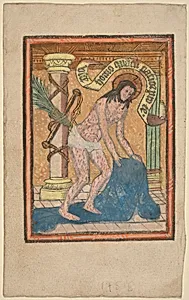
The Man of Sorrows
Medium
hand-colored woodcut on laid paper
Dimensions
image: 9.9 × 7.2 cm (3 7/8 × 2 13/16 in.) sheet (irregular): 14 × 8.6 cm (5 1/2 × 3 1/2 in.)
Classification
Department
CG-E
Museum
National Gallery of Art, Washington, D.C.
Credit
Rosenwald Collection
Accession Number
1943.3.806
Rights
Public Domain
Art Historical Context
Created around 1490 in the Netherlands or France, *The Man of Sorrows* is a delicate hand-colored woodcut that captures a deeply personal moment of Christian devotion. The image portrays Christ displaying his wounds, a traditional iconography designed to encourage meditation on his suffering and sacrifice. Measuring just under four inches tall, this intimate print was likely intended for private prayer rather than public display. Woodcuts like this one represent an important turning point in art history. As one of the earliest forms of printed imagery, they allowed religious subjects to reach a broader audience beyond wealthy church patrons. The addition of hand-coloring—applied individually to each impression—gave each copy a unique, handmade quality even as the carved block enabled wider distribution. Housed in the National Gallery of Art’s Rosenwald Collection, this small yet powerful work reflects the growing demand for affordable devotional images in the late fifteenth century, bridging the worlds of medieval piety and the emerging print culture of the Renaissance.