
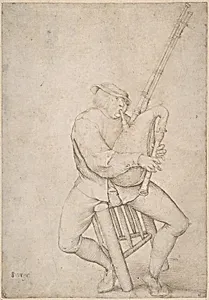
Seated Man, Precariously Balanced, Playing Bagpipes
Medium
Pen and brown ink
Dimensions
11 x 7 11/16 in. (28 x 19.5 cm)
Classification
Drawings
Department
Drawings and Prints
Museum
Metropolitan Museum of Art, New York, NY
Credit
Bequest of Harry G. Sperling, 1971
Accession Number
1975.131.172
Rights
Public Domain
Tags
Art Historical Context
This delightful 16th-century drawing, *Seated Man, Precariously Balanced, Playing Bagpipes*, captures a whimsical moment of everyday humor from the Netherlandish Renaissance. Attributed variably to Pieter Bruegel the Elder or an anonymous artist of the period, it showcases the keen observation of peasant life typical of Bruegel's circle. The seated figure teeters on an unstable perch, bagpipes in full swell, embodying the earthy, satirical spirit of Northern European art that celebrated (and poked fun at) common folk amid the era's social upheavals. Rendered in pen and brown ink—a favored medium for rapid, expressive sketches—the work's modest scale (11 x 7 11/16 inches) suggests it was a preparatory study or standalone sheet, prized for its lively line work and dynamic pose. Brown ink, often derived from oak galls, allowed for fluid shading and texture, highlighting the man's precarious balance and the bagpipes' bulging form. Bagpipes, a staple of folk music in the Low Countries, evoke raucous village festivities, adding cultural resonance to this snapshot of 16th-century life. Now housed in the Metropolitan Museum of Art's Drawings and Prints department through the bequest of Harry G. Sperling in 1971, this piece invites visitors to appreciate the artistry in the ordinary— a testament to the enduring charm of Netherlandish draftsmanship.
About the Artist
Pieter Bruegel the Elder|Anonymous, Netherlandish, 16th century · 1525–1569
Pieter Bruegel the Elder, a pioneering Netherlandish painter of the Renaissance, was born around 1525–1530, likely in Breda in the Duchy of Brabant (present-day Netherlands). Little is known of his early family background, but he apprenticed under the Antwerp painter and designer Pieter Coecke van Aelst between approximately 1545 and 1550, mastering tapestry design, architecture, and painting tech...