
Seated Transcendent Buddha Akshobhya (?)
Unknown Artist
second half of the 10th century
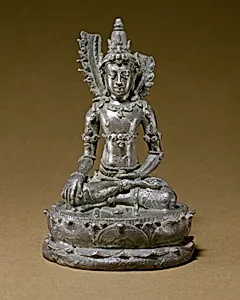
Medium
Silver
Dimensions
H. 3 3/4 in. (9.5 cm)
Classification
Sculpture
Culture & Period
Indonesia (Java) · Eastern Javanese period
Department
Asian Art
Museum
Metropolitan Museum of Art, New York, NY
Credit
Samuel Eilenberg Collection, Gift of Samuel Eilenberg, 1987
Accession Number
1987.142.11
Rights
Public Domain
Tags
Art Historical Context
This delicate silver sculpture, tentatively identified as the Seated Transcendent Buddhashobhya, hails from Java, Indonesia, during the Eastern Javanese period in the second half of the10th century. Standing just 3 3/4 inches tall, its petite scale suggests it was crafted for personal devotion or portable worship, a common practice in medieval Southeast Asian Buddhist art. The unknown artist's mastery of silver—likely hammered or repoussed—captures the serene poise of the Buddha in a meditative seated posture, embodying spiritual transcendence. Akshobhya, one of the five Dhyani Buddhas in Vajrayana Buddhism, represents the eastern direction and mirror-like wisdom, helping devotees purify anger and mirror reality without distortion. In 10th-century Java, under Hindu-Buddhist kingdoms like Mataram, such icons reflected the syncretic flourishing of Mahayana and tantric traditions, blending Indian influences with local Javanese aesthetics. This rare silver piece, from the Samuel Eilenberg Collection at The Metropolitan Museum of Art, highlights the era's technical sophistication and the role of precious metals in evoking divine luminosity. Its survival underscores the fragility and reverence for these intimate sacred objects, offering visitors a glimpse into Java's golden age of Buddhist artistry.