
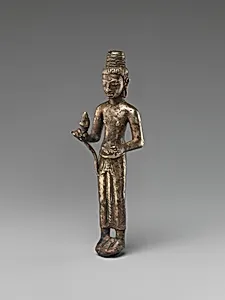
Standing Bodhisattva, probably Maitreya
Unknown Artist
7th–8th century
Medium
Silver alloy
Dimensions
H. 3 3/4 in. (9.5 cm)
Classification
Sculpture
Culture
Thailand (Buriram province, Prakhon Chai)
Department
Asian Art
Museum
Metropolitan Museum of Art, New York, NY
Credit
Gift of Evelyn Kossak, The Kronos Collections, 1995
Accession Number
1995.570.8
Rights
Public Domain
Tags
Art Historical Context
This exquisite Standing Bodhisattva, likely Maitreya—the future Buddha in Buddhist cosmology—stands as a rare from 7th–8th Thailand, specifically the Buriram province's Prakhon Chai region Crafted from silver alloy, this diminutive sculpture measures just 3/4 inches (9.5 cm) tall, suggesting it was a personal devotional object, perhaps carried by pilgrims or placed in a household shrine. Its graceful standing pose, with one hand possibly raised in a gesture of boon-granting (varada mudra), embodies the compassionate ideal of bodhisattvas: enlightened beings who postpone their own nirvana to aid humanity. Emerging during a pivotal era in Southeast Asian Buddhism, influenced by Dvaravati and early Khmer cultures, the figure reflects the spread of Mahayana traditions from India through trade routes. The use of silver alloy highlights advanced metalworking techniques, where artisans skillfully cast and chased fine details like flowing robes and serene facial features, evoking a sense of divine tranquility. Such small-scale works were prized for their portability and spiritual potency. Today, housed in the Metropolitan Museum of Art's Asian Art Department as a gift from Evelyn Kossak of The Kronos Collections (1995), this bodhisattva invites visitors to ponder the enduring role of Buddhism in Thai heritage—bridging ancient devotion with timeless hope for enlightenment.