
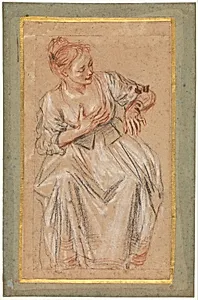
Seated Woman
1716–17
Medium
Black, red and white chalk
Dimensions
9 7/16 x 5 7/16 in. (24 x 13.8 cm)
Classification
Drawings
Department
Robert Lehman Collection
Museum
Metropolitan Museum of Art, New York, NY
Credit
Robert Lehman Collection, 1975
Accession Number
1975.1.763
Rights
Public Domain
Tags
Art Historical Context
Antoine Watteau's *Seated Woman*, created around 1716–17, captures the elegance of the French Rococo era in a delicate drawing executed in black, red, and chalk. Measuring just 9 7/16 x 5 7/16 inches, this intimate study exemplifies Watteau's mastery of the *trois crayons* technique—a method he perfected, layering vibrant red for warmth, white for highlights, and black depth to evoke lifelike volume and grace on prepared paper. As one of the era's pioneering Rococo artists, Watteau moved away from the grandeur of Baroque toward playful, atmospheric scenes of leisure, and his drawings often served as preparatory sketches for his famed *fêtes galantes* paintings. This work, housed in the Robert Lehman Collection at The Metropolitan Museum of Art since 1975, highlights Watteau's prodigious draftsmanship during his final years. Though he died young at 36, his fluid lines and subtle modeling influenced generations, bridging the opulent courts of Louis XIV and XV. For visitors, *Seated Woman* offers a glimpse into the artist's studio practice, where everyday poise becomes timeless artistry—perfect for contemplating the quiet beauty behind his exuberant canvases.
About the Artist
Antoine Watteau · 1684–1721
Jean-Antoine Watteau, born in 1684 in Valenciennes to a modest family—his father a roofer named Jean-Philippe Watteau—was the second of four sons who displayed an early passion for art. After initial apprenticeship under local painter Jacques-Albert Gérin, he moved to Paris around 1702, working in workshops copying Flemish and Dutch genre scenes. By 1705, he entered the studio of Claude Gillot, ab...