
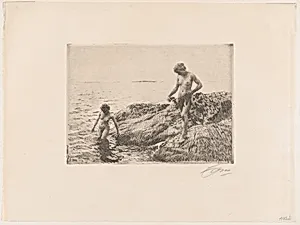
Seaward Skerries
1913
Medium
Etching; only state
Dimensions
Plate: 7 1/16 × 9 13/16 in. (18 × 25 cm) Sheet: 12 7/8 × 16 15/16 in. (32.7 × 43.1 cm)
Classification
Prints
Department
Drawings and Prints
Museum
Metropolitan Museum of Art, New York, NY
Credit
Harris Brisbane Dick Fund, 1917
Accession Number
17.3.710
Rights
Public Domain
Tags
Art Historical Context
Anders Zorn’s *Seaward Skerries* (1913) is a finely wrought etching that reflects the Swedish artist’s lifelong fascination with the nude figure in the open air. Zorn, celebrated for his virtuoso printmaking, produced this work in a single state, allowing the composition to stand as he first conceived it. The modest plate size belies the richness of tone he achieved through delicate cross-hatching and subtle wiping of the ink, techniques that give the scene a luminous, almost painterly quality. The subject—a group of women bathing among the rocky skerries of the Swedish coast—embodies Zorn’s recurring interest in the interplay of water, light, and skin. Rather than idealizing the figures, he records the casual, unselfconscious moment with naturalistic warmth, evoking the bracing freshness of the northern sea. The contrast between the smooth bodies and the jagged shoreline underscores his skill at suggesting both tactile reality and atmospheric depth within the constraints of black-and-white printmaking. Acquired by the Metropolitan Museum in 1917, the etching exemplifies how Zorn elevated the etching medium to the level of fine art at the turn of the twentieth century. Visitors today can appreciate the quiet intimacy of the scene while recognizing the technical mastery that made Zorn one of the most admired printmakers of his era.
About the Artist
Anders Zorn · 1860–1920
Anders Zorn (1860–1920), one of Sweden's most celebrated artists, was born on February 18 in Utmeland near Mora in Dalarna, and raised on his maternal grandparents' farm in the nearby hamlet of Yvraden. Displaying prodigious talent from a young age, he attended school in Mora Strand until age twelve, followed by secondary grammar school in Enköping, where he excelled in drawing people and horses. ...