
Second View of the Colosseum
probably 1550
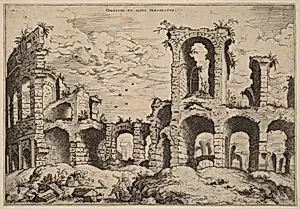
Medium
etching on laid paper
Dimensions
sheet (trimmed to plate mark): 23.4 × 33.9 cm (9 3/16 × 13 3/8 in.) mount: 31.9 × 45 cm (12 9/16 × 17 11/16 in.)
Classification
Department
CG-E
Museum
National Gallery of Art, Washington, D.C.
Credit
Ailsa Mellon Bruce Fund
Accession Number
1994.80.4
Rights
Public Domain
Art Historical Context
**Second View of the Colosse** by Hieronymus Cock, created around 1550, captures the majestic ruins of Rome's iconic amphitheater through the innovative medium of etching on laid paper. This intimate sheet, measuring about 23.4 × 33.9 cm, belongs to a series of panoramic views that Cock, a leading Flemish printmaker from Antwerp, produced to bring the grandeur of ancient Rome to Northern European audiences. Though Cock never visited Italy himself, he drew from on-site sketches by artists like Maarten van Heemskerck, transforming them into precise, atmospheric etchings that evoke the weathered stones and vast arches of the Colosseum under a dramatic sky. Etching allowed Cock to achieve fine, expressive lines and tonal depth, distinguishing his work from earlier woodcuts and making these prints highly collectible. As part of the Renaissance fascination with classical antiquity, this piece played a key role in disseminating architectural knowledge across Europe, inspiring architects, painters, and scholars during a time when rediscovering Rome's past fueled the era's artistic revival. Today, housed in the National Gallery of Art, *Second View of the Colosseum* reminds us how prints democratized grand tourism, offering a window into history's enduring monuments for those who could never make the pilgrimage themselves.
About the Artist
Hieronymus Cock · 1510–1570
Hieronymus Cock, born Hieronymus Wellens de Cock in Antwerp in 1518, emerged from a distinguished artistic lineage; his father, Jan Wellens de Cock, and brother, Matthys Cock, were both accomplished painters and draftsmen. Admitted as a master painter to Antwerp's Guild of Saint Luke in 1545, he honed his skills in the vibrant Netherlandish tradition before traveling to Rome from 1546 to 1547, whe...