
Secrétaire à abattant
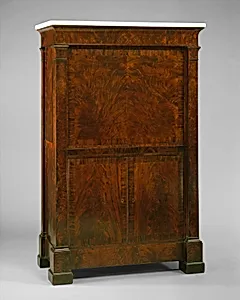
Medium
Mahogany, mahogany veneer, yellow poplar, white pine, gilded brass, mirrored plate glass, marble, ivory
Dimensions
62 x 39 1/4 x 18 7/8 in. (157.5 x 99.7 x 47.9 cm)
Classification
Secretary abattant
Culture
American
Department
The American Wing
Museum
Metropolitan Museum of Art, New York, NY
Credit
Purchase, The Manney Collection Gift, 1983
Accession Number
1983.225
Rights
Public Domain
Art Historical Context
This elegant Secrétaire à abattant, crafted between 1835 and 1847 by Duncan Phyfe’s New York workshop (operating as D. Phyfe & Son or Duncan Phyfe & Sons), represents the refined taste of antebellum American furniture making. The form—a drop-front writing desk with concealed compartments—draws from French precedents, yet it was executed in the United States during a period when Phyfe’s firm adapted European neoclassical and emerging revival styles to suit prosperous urban clients. Standing over five feet tall, the piece would have served both practical and display functions in a well-appointed parlor or library. Its rich materials underscore the workshop’s technical mastery. Mahogany and mahogany veneer provide a lustrous surface, accented by gilded brass mounts, a marble top, and ivory details, while mirrored glass enhances the interior. Yellow poplar and white pine form the secondary structure, typical of sturdy American construction. These choices reflect the high standards of Phyfe’s later production, when the firm continued to supply finely finished furniture even as tastes shifted toward more ornate Victorian designs. Acquired by the Metropolitan Museum of Art through the Manney Collection Gift in 1983, the secrétaire now resides in the American Wing. It offers visitors a tangible connection to early nineteenth-century craftsmanship, illustrating how New York artisans blended international influences with local resources to create objects of lasting beauty and utility.
About the Artist
Duncan Phyfe|D. Phyfe & Son|Duncan Phyfe & Sons · 1770–1854
Duncan Phyfe (1770–1854) was a Scottish-born American cabinetmaker who became the most celebrated furniture maker in the history of American decorative arts. Born Duncan Fife near Loch Fannich in the Scottish Highlands, he emigrated with his family to Albany, New York, around 1783–84, where he apprenticed to a cabinetmaker. By 1792 he had established his own workshop on Partition Street (later Ful...