
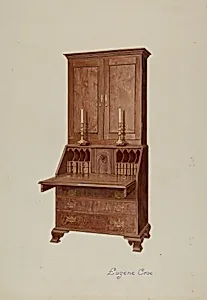
Secretary-desk Cabinet Top
c. 1937
Medium
watercolor, colored pencil, pen and ink, graphite,and heightening on paperboard
Dimensions
overall: 35.5 x 24.4 cm (14 x 9 5/8 in.) Original IAD Object: Upper: 43"high; 36"wide; 10 1/2"deep; Desk: 42 3/4"high; 38"wide; 21 1/2"d.
Classification
Index of American Design
Department
CG-W
Museum
National Gallery of Art, Washington, D.C.
Credit
Index of American Design
Accession Number
1943.8.5417
Rights
Public Domain
Art Historical Context
This vibrant rendering by Eugene Croe, titledSecretary-desk Cabinet Top* and dated around 1937, captures intricate details of an elegant American furniture piece from the 18th or early 19th century Crafted in watercolor, colored pencil, and ink, graphite, heightening on paperboardmeasuring 35.5 x 24.4 cm), the work showcases the cabinet's graceful proportions—its upper section standing 43 inches high, 36 inches, and 10½ deep, paired with a desk of similar stature. Croe's meticulous technique highlights the wood grains, moldings, and hardware with luminous precision, bringing the object's craftsmanship to life. As part of the Index of American Design (IAD), a landmark WPA Federal Art Project from the Great Depression era, this piece exemplifies a national effort to document and celebrate America's decorative arts heritage. Over 15,000 such renderings were created by artists across the country, preserving folk and fine objects threatened by time or neglect. Housed in the National Gallery of Art's collection, Croe's study underscores the IAD's blend of artistic skill and scholarly accuracy, making antique designs accessible to modern eyes. Fun fact: These IAD works weren't mere copies—they elevated everyday American craftsmanship into fine art, influencing mid-20th-century design revivals and reminding us of the ingenuity in our shared past.
About the Artist
Eugene Croe · 1875–1953
Eugene Croe (c. 1875–1953) was an American artist whose career is primarily documented through his contributions to the Index of American Design, a Federal Art Project under the Works Progress Administration (WPA) during the 1930s and 1940s. This ambitious initiative commissioned artists to create precise illustrations of American folk art, decorative arts, and everyday objects, preserving a visua...