
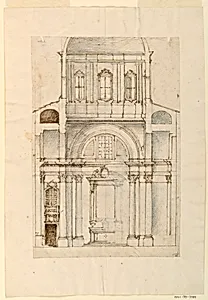
Section of an apse
Classification
architecture
Department
Smithsonian Collection
Museum
Smithsonian American Art Museum
Credit
Museum purchase through gift of various donors and from Eleanor G. Hewitt Fund
Accession Number
1938-88-3789
Rights
Public Domain
About this artwork
Research in Progress
Art Historical Context
Filippo Marchionni’s “Section of an Apse,” created around 1780, offers a glimpse into the architectural imagination of late-eighteenth-century Italy. As a trained architect and draftsman, Marchionni captured the curved, recessed space that traditionally frames the altar in churches, emphasizing proportion, light, and ornamental detail. Though the precise medium remains under study, the work’s classification as architecture suggests it may be a drawing or preparatory study intended to guide builders or patrons. Apse designs like this one played a central role in shaping the spiritual experience of worshippers, directing attention toward the sacred center of the building. Marchionni’s careful rendering reflects the period’s interest in classical harmony and theatrical effect, qualities that would have resonated in both ecclesiastical and civic projects of the era. Acquired by the Smithsonian American Art Museum through the generosity of many donors and the Eleanor G. Hewitt Fund, the piece invites ongoing research. Visitors are encouraged to consider how such architectural fragments connect artistic vision with the lived spaces of the past.