
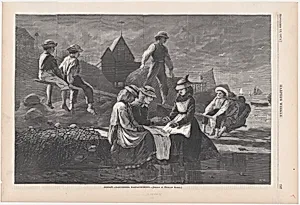
Seesaw, Gloucester, Massachusetts (from "Harper's Weekly," Vol. XVIII)
September 12, 1874
Medium
Wood engraving
Dimensions
image: 9 1/8 x 13 3/4 in. (23.2 x 34.9 cm) sheet: 10 13/16 x 15 15/16 in. (27.5 x 40.5 cm)
Classification
Prints
Department
Drawings and Prints
Museum
Metropolitan Museum of Art, New York, NY
Credit
Harris Brisbane Dick Fund, 1928
Accession Number
28.111.6(9)
Rights
Public Domain
Tags
Art Historical Context
Winslow Homer's *Seesaw, Gloucester Massachusetts*, published in *Harper's Weekly* on September 12, 1874, captures a joyful moment of childhood play in a coastal New England town. This wood engraving depicts boys gleefully balancing on a seesaw amid quaint houses, with women nearby, evoking the simple pleasures of 19th-century American life. Rendered in intricate black-and-white lines, the 9 1/8 x 13 3/4-inch image (sheet: 10 13/16 x 15 15/16 inches) draws viewers into Gloucester's everyday scene, a hub for fishing and summer visitors. As a master of American Realism, Homer frequently contributed to *Harper's Weekly*, using wood engravings to document post-Civil War society with vivid detail and authenticity. This medium, popular for mass-produced periodicals by publishers Harper & Brothers, allowed Homer's precise cross-hatching and dynamic compositions to reach wide audiences, bridging fine art and illustration. The work highlights leisure amid industrial growth, showcasing Homer's affinity for maritime themes and candid human interactions. Acquired through the Harris Brisbane Dick Fund in 1928, this print from the Metropolitan Museum of Art's Drawings and Prints department offers a window into Victorian-era innocence, reminding us how art preserved fleeting joys in a changing America.
About the Artist
Winslow Homer|Harper's Weekly|Harper & Brothers · 1836–1910
Winslow Homer (1836-1910) was one of America's greatest painters and a preeminent figure in 19th-century American art. Largely self-taught, Homer began his career as a commercial illustrator and Civil War correspondent for Harper's Weekly before becoming renowned for his powerful marine subjects and landscape paintings. His mastery of both oil and watercolor, combined with his uncompromising reali...