
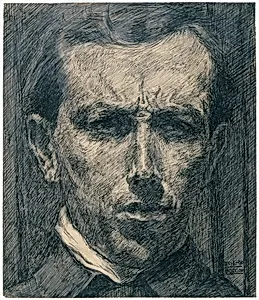
Self-Portrait
1910
Medium
Ink, wash and graphite on paper
Dimensions
10 1/4 x 8 3/4 in. (26 x 22.2 cm)
Classification
Drawings
Department
Modern and Contemporary Art
Museum
Metropolitan Museum of Art, New York, NY
Credit
Bequest of Lydia Winston Malbin, 1989
Accession Number
1990.38.12
Rights
Public Domain
Tags
Art Historical Context
Umberto Boccioni's *Self-Portrait* (1910) captures the Italian artist at a pivotal moment in his career, just as Futurism burst onto the scene. A founding member of this revolutionary movement—launched with the 1909 Futurist Manifesto—Boccioni sought to depict the dynamism of modern life through fragmented forms and motion. Created in ink, wash, and graphite paper, this intimate drawing (10¼ × 8¾ in.) reflects his early experimentation, bridging his Divisionist roots with the explosive energy that would define Futurist masterpieces like his later sculptures. The work's modest scale and mixed media suggest a personal study, likely a preparatory sketch revealing Boccioni's intense self-scrutiny. His angular features and shadowed expression hint at the psychological depth and velocity he would soon amplify in paintings such as *The City Rises* (1910). As a self-portrait, it embodies Futurism's embrace of the individual artist as a force of innovation, challenging static traditions. Housed in the Metropolitan Museum of Art's Modern and Contemporary Art department through the bequest of Lydia Winston Malbin in 1989, this drawing offers visitors a glimpse into Boccioni's transformative vision. Tragically cut short by his death in 1916, his legacy endures as a cornerstone of early 20th-century avant-garde art.
About the Artist
Umberto Boccioni · 1882–1916
Umberto Boccioni (1882–1916) was an Italian painter and sculptor who became the leading artist and principal theorist of the Futurist movement. Born in Reggio Calabria, he studied in Rome under the Divisionist painter Giacomo Balla and was deeply influenced by Post-Impressionism before encountering the ideas of Filippo Tommaso Marinetti, whose 1909 Futurist Manifesto catalyzed Boccioni's artistic ...