
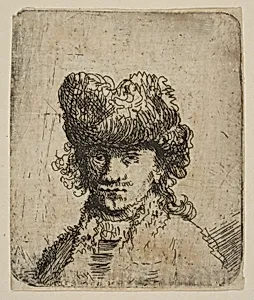
Self-Portrait in a Fur Cap: Bust
18th century
Medium
Etching
Dimensions
Sheet (trimmed): 2 1/2 × 2 1/16 in. (6.3 × 5.3 cm)
Classification
Prints
Department
Drawings and Prints
Museum
Metropolitan Museum of Art, New York, NY
Credit
Gift of Harry G. Friedman, 1957
Accession Number
57.658.93
Rights
Public Domain
Tags
About this artwork
This small etching represents an eighteenth-century copy after one of Rembrandt's most intimate self-portraits, originally created around 1630 when the artist was in his early twenties. The original etching shows Rembrandt wearing a fur cap, studying his own features with the intense observation that characterized his lifelong self-examination through printmaking. However, this impression is a later copy, probably made in the 1700s when interest in Rembrandt's prints experienced renewed enthusia...
Art Historical Context
This intimate etching, titled *Self-Portrait in a Fur: Bust*, is an 18th-century copy after one of Rembrandt van Rijn most personal works, originally created around 1630 the Dutch master was in his early twenties Measuring just 2½ × 2 1/16 inches, the trimmed sheet captures Rembrandt gazing intently at his own features beneath a fur cap, embodying his lifelong fascination with self-examination through printmaking. As a pioneer of Baroque etching, Rembrandt used these small-scale works to experiment with light, expression, and costume, creating more self-portraits in print than any artist before him—treating his face as a canvas for technical innovation and artistic identity. Though this impression lacks the original's psychological depth and technical finesse, it reflects the 1700s revival of interest in Rembrandt's prints among collectors and artists. Copyists reproduced his popular images to meet demand, preserving compositions that influenced later etchers studying self-representation. The fur cap and bust format highlight Rembrandt's ability to convey character in miniature, a hallmark of his etched oeuvre. Now in the Metropolitan Museum of Art's Drawings and Prints department—thanks to a 1957 gift from Harry G. Friedman—this tiny gem bridges Rembrandt's genius with centuries of admiration, inviting us to ponder the enduring power of self-portraiture.
About the Artist
Rembrandt (Rembrandt van Rijn) · 1606–1669
Rembrandt Harmenszoon van Rijn (1606–1669) stands as one of the greatest visual artists in the history of Western art and the most important Dutch painter of the 17th century. Born in Leiden to a prosperous miller's family, Rembrandt transformed painting through his revolutionary use of light and shadow, his psychological depth in portraiture, and his elevation of etching to a fine art. His approx...