
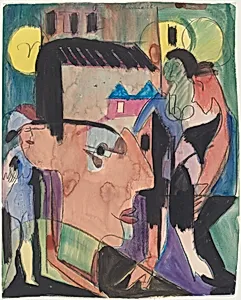
Self-Portrait
Medium
brush and ink with watercolor over black crayon
Dimensions
overall: 46.8 x 37.5 cm (18 7/16 x 14 3/4 in.)
Classification
Drawing
Department
CG-W
Museum
National Gallery of Art, Washington, D.C.
Credit
Gift of Ruth Cole Kainen
Accession Number
2012.92.20
Rights
Public Domain
Art Historical Context
Ernst Ludwig Kirchner's *Self-Portrait* (8) captures the raw emotional intensity characteristic of German Expressionism, a movement Kirchner helped pioneer as a founder of Die Brücke group in 1905. Created late in his career, this work reflects the artist's turbulent life: after serving in World War I, which shattered his health, Kirchner retreated to Switzerland in 191, grappling with mental anguish and opium addiction. By 1928, his self-portraits often conveyed a haunting introspection, using distorted forms and bold colors to externalize inner turmoil—a hallmark of Expressionist rebellion against academic realism. Executed in brush and ink with watercolor over black crayon on paper (46.8 x 37.5 cm), the piece exemplifies Kirchner's mastery of mixed media. The fluid ink lines and layered watercolor allow for dynamic contrasts and vibrant hues, amplifying expressive energy typical of his drawings. Unlike his earlier woodcuts, this softer technique reveals a more vulnerable side, blending precision with spontaneity. Now housed in the National Gallery of Art as a gift from Ruth Cole Kainen, this drawing underscores Kirchner's enduring influence. Despite the Nazis branding his work "degenerate" in 1937—forcing him to destroy many pieces—survivors like this one affirm his role in modern art's emotional depth, inviting viewers to confront the human psyche.
About the Artist
Ernst Ludwig Kirchner · 1880–1938
Ernst Ludwig Kirchner was born on May 6, 1880, in Aschaffenburg, Germany, to parents Ernst and Maria Kirchner, part of a family of Prussian descent that frequently relocated due to his father's career as a chemical technician. After early schooling in various towns, he studied architecture at the Königliche Technische Hochschule (Technical University) in Dresden from 1901 to 1905, taking courses i...