
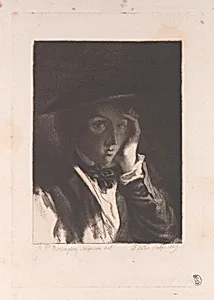
Self-portrait of Richard Parkes Bonington
Medium
Etching with roulette
Dimensions
Sheet: 8 5/8 × 6 7/8 in. (21.9 × 17.4 cm) Plate: 7 1/16 × 4 15/16 in. (17.9 × 12.6 cm)
Classification
Prints
Department
Drawings and Prints
Museum
Metropolitan Museum of Art, New York, NY
Credit
The Elisha Whittelsey Collection, The Elisha Whittelsey Fund, 2020
Accession Number
2020.258
Rights
Public Domain
Tags
Art Historical Context
Richard Parkes Bonington (2–1828), a gifted English painter renowned for his luminous landscapes and scenes, is captured in this intimate self-portrait etching produced posthumously in 1847 by French engraver Frédéric Vill. Bonington, who bridged British Romanticism and French plein-air traditions, influenced artists like Delacroix and Corot before his early death from tuberculosis. This print reproduces one of his known self-portraits, offering a glimpse into the artist's thoughtful gaze and refined features. Crafted in etching with roulette—a technique using a textured wheel to create velvety, tonal effects—Villot's print exemplifies 19th-century reproductive printmaking. The roulette adds a soft, painterly quality, mimicking Bonington's delicate watercolor style and allowing wider dissemination of his image. Measuring modestly at about 8 x 7 inches on the sheet, it highlights the precision of intaglio processes popular in European ateliers. Housed in the Metropolitan Museum of Art's Drawings and Prints department, this work from The Elisha Whittelsey Collection celebrates Bonington's enduring legacy. For visitors, it's a poignant reminder of how prints preserved the faces and spirits of artists lost too soon, blending technical innovation with personal revelation.
About the Artist
Richard Parkes Bonington|Richard Parkes Bonington|Frédéric Villot · 1802–1828
Richard Parkes Bonington (1802–1828) was a British painter and watercolorist who, despite dying at the age of twenty-five, produced a body of work that had a profound and lasting influence on French and British painting. Born in Arnold, near Nottingham, he moved with his family to Calais and then Paris in 1817, where he studied at the École des Beaux-Arts under Antoine-Jean Gros and copied Old Mas...