
Semiramis on the Lion Hunt
1601 to 1650
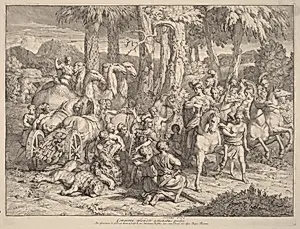
Medium
engraving and etching
Classification
Department
CG-E
Museum
National Gallery of Art, Washington, D.C.
Credit
Andrew W. Mellon Fund
Accession Number
1977.80.4
Rights
Public Domain
Art Historical Context
Gerard de Lairesse's *Semiramis on the Lion Hunt*, created between 1601 and 1650, captures the legendary Assyrian queen Semiramis in a dynamic moment of bravery and power. Renowned in ancient lore for her conquests and architectural feats, Semiramis is depicted here amid a thrilling lion hunt, embodying themes of feminine strength and heroism that resonated in 17th-century European art. Lairesse, a Dutch Baroque master influenced by Rubens and classical antiquity, infused his works with elegant, idealized figures and dramatic narratives, making this print a prime example of his skill in historical and mythological subjects. Crafted through engraving and etching—a combination prized for its precision and expressive freedom—this medium allowed intricate details in textures, from the lions' fur to the queen's flowing drapery. Prints like this were revolutionary in the Dutch Golden Age, enabling widespread dissemination of grand artistic visions to collectors and scholars beyond elite patrons. Acquired through the Andrew W. Mellon Fund for the National Gallery of Art's Department of Prints (CG-E), it highlights the era's innovative printmaking techniques. This artwork invites visitors to ponder Semiramis's enduring myth, bridging ancient legend with Baroque grandeur and showcasing how prints democratized high art.
About the Artist
Gerard de Lairesse · 1641–1711
Gerard de Lairesse (1641–1711) was a leading figure of the Dutch Golden Age, renowned as both a painter and art theorist whose classical ideals bridged the dramatic realism of Rembrandt with the refined elegance of French academism. Born on September 11, 1641, in Liège, he was the second son of the painter Renier de Lairesse (1597–1667). De Lairesse received his initial training under his father b...