
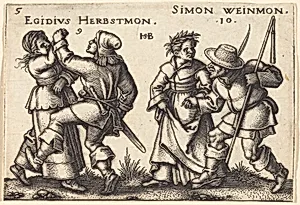
September and October
1546/1547
Medium
engraving
Classification
Department
CG-E
Museum
National Gallery of Art, Washington, D.C.
Credit
Rosenwald Collection
Accession Number
1963.11.20
Rights
Public Domain
Art Historical Context
Sebald Beham's *September and October* (6/1547) is a exquisite engraving from the National Gallery Art's Rosenwald Collection exemplifying the mastery of the German "Little Masters" during the Northern Renaissance. Beham, a Nuremberg artist influenced by Albrecht Dürer, specialized in intricate small-scale prints that captured everyday life with remarkable precision. This work likely belongs to his series depicting the twelve months, a popular Renaissance motif blending calendar imagery with scenes of rural labor and seasonal change. As an engraving, the piece showcases Beham's virtuosic technique: fine lines incised into a copper plate create textures of foliage, clothing, and landscapes, allowing for rich tonal contrasts when inked and printed. Produced in the mid-16th century, such prints were affordable art forms, disseminating humanist ideals of harmony between humans and nature to a wide audience beyond elites. Culturally, *September and October* evokes the harvest season's bounty and toil, reflecting the agrarian rhythms of Reformation-era Europe. Its detailed peasant figures offer a vivid snapshot of 16th-century life, blending realism with subtle moral undertones. A gem for print enthusiasts, it highlights engraving's role in democratizing art. (198 words)
About the Artist
Sebald Beham · 1500–1550
Sebald Beham (1500–1550), a pioneering German printmaker and painter born in Nuremberg, emerged as one of the most prolific artists of the Northern Renaissance. The elder brother of fellow artist Barthel Beham, he grew up in a milieu steeped in artistic tradition, though details of his early training remain sparsely documented. Recorded as a journeyman painter (Malergeselle) by 1521 and a master w...