
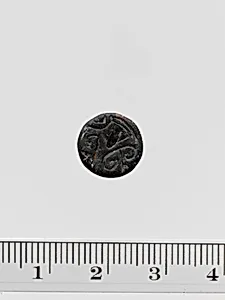
Serpentine hemispheroid seal
Unknown Artist
ca. 1900–1750 BCE
Medium
Serpentine
Dimensions
Diameter 1.25 cm; H. 0.6 cm
Classification
Gems
Culture & Period
Minoan · Middle Minoan II
Department
Greek and Roman Art
Museum
Metropolitan Museum of Art, New York, NY
Credit
Bequest of Richard B. Seager, 1926
Accession Number
26.31.127
Rights
Public Domain
Tags
Art Historical Context
This exquisite serpentine hemispheroid, crafted around 1900–1750 BCE during the Middle Minoan II, offers a tantalizing glimpse into the vibrant world of Minoan Crete. Carved from lustrous green serpentine—a-precious stone prized for smooth texture and durability—the seal measures just 1.25 cm in diameter 0.6 cm high. Its compact, half-sphere shape made it perfect for stamping clay impressions, likely used to secure documents, storage jars, or goods, signifying ownership or administrative authority in this advanced Bronze Age society. Engraved on its flat surface are Minoan hieroglyphs, an early script predating the later Linear A, hinting at a sophisticated bureaucratic system in Minoan palaces like Knossos. The unknown artisan's mastery of intaglio carving on such a tiny scale demonstrates remarkable precision, transforming a functional object into a work of art. Serpentine's rarity elevated seals like this into status symbols, reflecting Minoan ingenuity in gem-cutting techniques. Bequeathed to the Metropolitan Museum of Art in 1926 by archaeologist Richard B. Seager, who excavated Cretan sites, this gem illuminates the Minoans' cultural legacy—innovative traders and builders whose undeciphered writing continues to intrigue scholars today. A small treasure with big stories!