
Steatite triangular prism
Unknown Artist
ca. 2200–1900 BCE
Medium
Serpentine
Dimensions
L. 1.45 cm; W. of each face 1 cm
Classification
Gems
Culture & Period
Minoan · Middle Minoan I
Department
Greek and Roman Art
Museum
Metropolitan Museum of Art, New York, NY
Credit
Bequest of Richard B. Seager, 1926
Accession Number
26.31.137
Rights
Public Domain
Tags
Art Historical Context
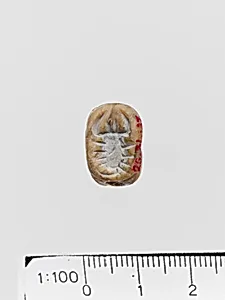
This diminutive steatite triangular prism, carved from smooth serpentine stone around 2200–1900 BCE, offers a rare glimpse into the early world of Minoan Crete during the Middle Minoan I period. Measuring just 1.45 cm long with 1 cm faces, it belongs to a class of small gems likely used as seals, amulets, or jewelry. Excavated artifacts like this one highlight the Minoans' mastery of miniature carving, a technique enabled by serpentine's soft, workable texture, which allowed intricate details on such a tiny scale. Each face of the prism features engraved motifs of men and scorpions, evoking themes of human interaction with the natural—or perhaps supernatural—world. Scorpions, potent symbols in ancient Mediterranean cultures, might represent protection, danger, or fertility rites, while the stylized human figures suggest ritual or narrative scenes. Though the artist remains unknown, this gem reflects the Minoans' innovative glyptic art, bridging Prehistoric Aegean traditions with later Greek seal-making. Bequeathed to the Metropolitan Museum of Art in 1926 by Richard B. Seager, a pioneering American archaeologist on Crete, this artifact underscores the Minoans' vibrant Bronze Age society—peaceful seafarers and traders whose enigmatic symbols continue to intrigue. Up close, it invites wonder at how such precision captured cosmic tensions in stone.