
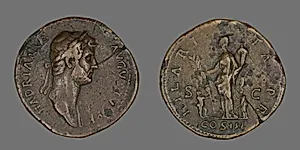
Sestertius (Coin) Portraying Emperor Hadrian
128-132
Medium
Bronze
Dimensions
Diam.: 3.4 cm (1 3/8 in.)
Classification
coin
Department
Arts of Greece, Rome, and Byzantium
Museum
Art Institute of Chicago
Accession Number
141703
Rights
Public Domain
Art Historical Context
This bronze sestertius, struck during Emperor Hadrian's reign (–138 CE) between 128 and 132 CE, exemplifies the artistry and propaganda of ancient Roman coinage. Measuring just 3.4 cm in, it features a detailed portrait of Hadrian on obverse, likely laureate and togate, symbolizing his imperial authority. The reverse typically depicts deities, victories, or provincial symbols, reinforcing Rome's vast empire. As a mid-value denomination, sestertii circulated widely, making the emperor's image familiar to citizens from Britain to Egypt. Roman imperial coins like this were masterworks of die-engraving, showcasing realistic portraiture influenced by Greek traditions but distinctly individualized—Hadrian's thoughtful gaze reflects his philosopher-king persona. Minted in Rome or provincial workshops, the bronze alloy ensured durability for daily use while allowing intricate reliefs that wore gracefully over time. These coins were economic tools and political billboards, commemorating Hadrian's travels, building projects like the Pantheon, and border fortifications such as Hadrian's Wall. Housed in the Art Institute of Chicago's Arts of Greece, Rome, and Byzantium department, this sestertius offers a tangible link to Rome's golden age, blending artistry, history, and everyday life. Visitors can appreciate how such small objects shaped public perception of power.
About the Artist
Ancient Roman
The artists attributed to "Ancient Roman" in museum collections represent the anonymous craftsmen who produced the vast output of sculpture, frescoes, mosaics, and reliefs defining Roman visual culture from the Republic (c. 509–27 BCE) to the late Empire (c. 395 CE). Individual identities remain elusive, as Roman makers were typically viewed as skilled tradesmen—often enslaved Greeks or provincial...