
Sestertius (Coin) Portraying Emperor Severus Alexander
231-235
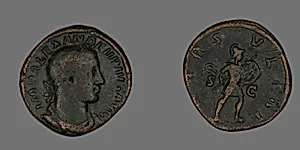
Medium
Bronze
Dimensions
Diam.: 3 cm (1 3/16 in.)
Classification
coin
Department
Arts of Greece, Rome, and Byzantium
Museum
Art Institute of Chicago
Accession Number
141729
Rights
Public Domain
Art Historical Context
This bronze sestertius, struck during the reign of Emperor Severus Alexanderr. 222–235 CE), offers a glimpse into the grandeur of late Roman imperial portraiture. Measuring just 3 cm in diameter, this from the Art Institute of Chicago's Arts of Greece, Rome, Byzantium collection captures the youthful emperor on the obverse, likely laureate and togate, embodying the idealized ruler. Minted around 231–235 CE, it reflects the final years of the Severan, a turbulent era bridging the Pax Romana and the Crisis of the Third Century. As a large-denomination bronze coin, the sestertius was a workhorse of Roman commerce, valued at a quarter of a denarius and used for everyday transactions. Roman coinage doubled as state propaganda: the obverse promoted the emperor's divine authority through precise engraving and high-relief portraits, while the reverse often featured deities, victories, or imperial virtues to legitimize rule. Severus Alexander's coins, influenced by his mother Julia Mamaea's influence, emphasized stability amid growing military pressures. These miniature masterpieces showcase ancient die-striiking techniques—hammering heated blanks between engraved dies—for remarkable detail on such a small scale. For visitors, this sestertius isn't just currency; it's a portable billboard of Roman power, blending artistry, economics, and politics in everyday metal.
About the Artist
Ancient Roman
The artists attributed to "Ancient Roman" in museum collections represent the anonymous craftsmen who produced the vast output of sculpture, frescoes, mosaics, and reliefs defining Roman visual culture from the Republic (c. 509–27 BCE) to the late Empire (c. 395 CE). Individual identities remain elusive, as Roman makers were typically viewed as skilled tradesmen—often enslaved Greeks or provincial...