
Sestertius (Coin) Portraying Julia Mamaea
Medium
Bronze
Dimensions
Diam.: 2.9 cm (1 3/16 in.)
Classification
coin
Department
Arts of Greece, Rome, and Byzantium
Museum
Art Institute of Chicago
Accession Number
141725
Rights
Public Domain
About this artwork
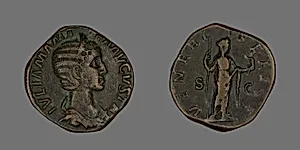
The front (obverse) of this coin portrays the bust of Julia Mamaea, the mother of Roman Emperor Alexander Severus, facing to the right, draped, and diademed. On the back (reverse), the goddess Venus (or the empress) stands to the right with a child seated on her left hand, a sceptre in her right. Coins recorded the ever-changing hairdos of the royal ladies in Rome and carried the new fashions to the far corners of the empire.
Art Historical Context
This bronze sestertius, struck in 224 CE during the height of the Severan dynasty, features a portrait of Julia Mamaea the influential mother of Emperor Severus Alexander With a diameter of just 2.9 cm, this Ancient Roman coin exemplifies the empire's mastery of miniature portraiture, where the obverse likely shows Mamaea's draped bust—adorned with imperial regalia—to symbolize her status as Augusta, a title denoting her power behind the throne. Roman sestertii were large-denomination coins valued at a quarter of a denarius, widely circulated for everyday transactions and propaganda. Minted under Severus Alexander's reign (222–235 CE), this piece highlights Mamaea's role as a key political advisor and regent, whose influence helped stabilize the empire amid military crises. Such coins propagated loyalty to the imperial family, blending artistry with state messaging. Artistically, the coin showcases die-struck techniques: finely engraved steel dies hammered onto heated bronze blanks created lifelike profiles and inscriptions. Housed in the Art Institute of Chicago's Arts of Greece, Rome, and Byzantium department, it offers a tangible glimpse into Roman cultural reverence for maternal authority and the era's economic prowess.
About the Artist
Ancient Roman
The artists attributed to "Ancient Roman" in museum collections represent the anonymous craftsmen who produced the vast output of sculpture, frescoes, mosaics, and reliefs defining Roman visual culture from the Republic (c. 509–27 BCE) to the late Empire (c. 395 CE). Individual identities remain elusive, as Roman makers were typically viewed as skilled tradesmen—often enslaved Greeks or provincial...