
Sestertius (Coin) Portraying King Philip II
244-246
Medium
Bronze
Dimensions
Diam.: 2.8 cm (1 1/8 in.)
Classification
coin
Department
Arts of Greece, Rome, and Byzantium
Museum
Art Institute of Chicago
Accession Number
141794
Rights
Public Domain
About this artwork
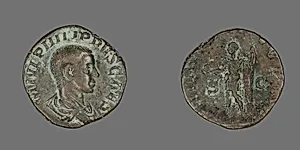
The front (obverse) of this coin portrays King Phillip II of Macedon, facing right. On the back (reverse) he is shown walking to the right, armed with a sceptre or spear and holding an orb.
Art Historical Context
This bronze sestertius struck in 244-246 CE during early reign of Roman Emperor Philip II (also as Philip the Arab), a tangible glimpse into the turbulent mid-third century Roman Empire. Measuring just 2.8 cm in diameter, this coin from the Art Institute of Chicago's Arts of Greece, Rome, Byzantium collection exemplifies the currency that circulated widely across the empire, from bustling markets to military camps. Philip II ascended to power amid crisis, co-ruling initially with his young son before sole rule, and this sestertius likely features his portrait on the obverse—a common imperial propaganda tool to disseminate the emperor's image and assert legitimacy. Sestertii, valued at a quarter of a denarius, were larger bronze coins ideal for detailed engraving, showcasing Roman minting prowess through hammered dies that created raised reliefs. The reverse might depict symbolic motifs like deities or victories, reinforcing cultural and political narratives. As both economic tool and artistic miniature, such coins highlight Rome's mastery of portraiture and mass production, preserving history in metal for posterity. Handling one today connects us to the citizens who traded it daily.
About the Artist
Ancient Roman
The artists attributed to "Ancient Roman" in museum collections represent the anonymous craftsmen who produced the vast output of sculpture, frescoes, mosaics, and reliefs defining Roman visual culture from the Republic (c. 509–27 BCE) to the late Empire (c. 395 CE). Individual identities remain elusive, as Roman makers were typically viewed as skilled tradesmen—often enslaved Greeks or provincial...