
Sestertius (Coin) Portraying Philip the Arab
244-249
Medium
Bronze
Dimensions
Diam.: 3.1 cm (1 1/4 in.)
Classification
coin
Department
Arts of Greece, Rome, and Byzantium
Museum
Art Institute of Chicago
Accession Number
141782
Rights
Public Domain
About this artwork
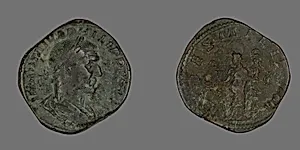
The front (obverse) of this coin portrays the head of Philip the Arab, facing to the right. The back (reverse) depicts the deity Fides (Faith) standing between two military standards.
Art Historical Context
Step into the world of ancient Rome with this striking bronze sestertius coin, minted during the reign of Emperor Philip the Arab (r. 244–249 CE). just 3.1 cm in diameter, this unassuming artifact from the Art Institute of Chicago's Arts of Greece, Rome and Byzantium department captures the emperor's portrait on its obverse, a common feature in Roman coinage designed to disseminate his image and authority across the vast empire. Philip, born in Arabia and the first Roman emperor of Arab descent, used such coins to proclaim his legitimacy amid turbulent times. The sestertius was a large-denomination bronze coin, valued at a quarter of a denarius, essential for everyday transactions and state payments. Struck with intricate dies, it exemplifies Roman minting techniques that blended artistry with propaganda—emperors' profiles often idealized to evoke strength and divinity, while reverses typically featured deities, victories, or imperial motifs. This piece reflects the economic backbone of the empire and Philip's short-lived rule, marked by celebrations like Rome's millennium in 248 CE. Today, in museum collections, these coins offer intimate glimpses into imperial power, daily life, and cultural fusion in the Roman world, reminding us how even pocket change shaped history.
About the Artist
Ancient Roman
The artists attributed to "Ancient Roman" in museum collections represent the anonymous craftsmen who produced the vast output of sculpture, frescoes, mosaics, and reliefs defining Roman visual culture from the Republic (c. 509–27 BCE) to the late Empire (c. 395 CE). Individual identities remain elusive, as Roman makers were typically viewed as skilled tradesmen—often enslaved Greeks or provincial...