
Set of Sword Fittings (Mitokoromono)
19th century
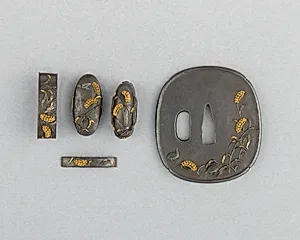
Medium
Iron, gold, copper-silver alloy (shibuichi)
Dimensions
sword guard (tsuba) (17.208.32a) 2 5/8 x 2 3/8 in. (6.7 x 6.0 cm); cord knob (kurigata) (17.208.32b) 1 1/4 x 3/4 in. (3.2 x 1.9 cm); socket brace for knife (uragawara) (17.208.32c) 1 1/4 x 3/4 in. (3.2 x 1.9 cm); pommel cap (kashira) (17.208.32d) 1 3/8 x 3/4 in. (3.5 x 1.9 cm); hilt collar (fuchi) (17.208.32e) 1 1/2 x 3/4 in. (3.8 x 1.9 cm); knife handle (kozuka) (17.208.42) L. 3 3/4 in. (9.5 cm)
Classification
Sword Furniture-Fittings, Sets of
Culture
Japanese
Department
Arms and Armor
Museum
Metropolitan Museum of Art, New York, NY
Credit
Gift of a Trustee of the Museum, 1917
Accession Number
17.208.32a–e, .42
Rights
Public Domain
Art Historical Context
This exquisite set of sword fittings, known as *Mitokoromono*, was crafted by the skilled Japanese metalworker Ginshtei Tōmei in 19th century during Japan's late Edo period. Comprising a sword guard (*tsuba*), cord knob (*kurigata socket brace (*uragara*), pommel capkashira*), hilt (*fuchi*), and handle (*kozuka*), small yet intricate pieces (ranging from 1¼ to 2⅝ inches) were essential components for decorating and functionalizing samurai swords. Acquired by the Metropolitan Museum of Art in 1917 as a gift from a museum trustee, they exemplify the fusion of weaponry and artistry in feudal Japan. Forged primarily from iron, with inlays of shimmering gold and shibuichi—a copper-silver alloy prized for its subtle, smoky patina—these fittings showcase advanced metalworking techniques like damascening and nunome-zogan (gold inlay hammered into etched iron). Such methods allowed artisans like Tōmei to create textured surfaces and vibrant contrasts, transforming utilitarian objects into wearable sculptures that reflected the wearer's status. In samurai culture, sword fittings were symbols of prestige and personal taste, blending martial tradition with aesthetic refinement. Even as Japan edged toward modernization in the 19th century, these works preserved centuries-old craftsmanship, offering visitors a window into the elegant lethality of the warrior class.