
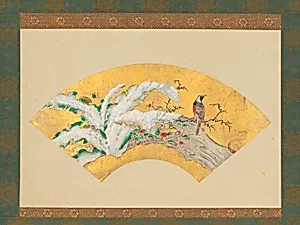
雪中芭蕉小禽図 (Setchū bashō shōkin zu)|Plantain and Bird in Snow
late 16th century
Medium
Fan-shaped painting mounted on a hanging scroll; ink, color, and gold leaf on paper
Dimensions
Image: 14 9/16 × 20 7/8 in. (37 × 53 cm) Overall with mounting: 50 13/16 × 26 3/16 in. (129 × 66.5 cm) Overall with knobs: 50 13/16 × 28 1/4 in. (129.1 × 71.8 cm)
Classification
Paintings
Culture & Period
Japan · Muromachi (1392–1573) or Momoyama (1573–1615) period
Department
Asian Art
Museum
Metropolitan Museum of Art, New York, NY
Credit
Mary and Cheney Cowles Collection, Gift of Mary and Cheney Cowles, 2020
Accession Number
2020.396.13
Rights
Public Domain
Tags
Art Historical Context
Behold *Plantain and Bird in Snow* (*Setchū bashō shōkin zu*), a delicate fan-shaped painting by Kano Sōshū, master of the renowned Kano school, from the late 16th century. Originally painted on paper with ink, vibrant colors, and shimmering gold leaf, it later mounted as a hanging scroll, transforming an intimate fan into a grand display piece. Measuring about 15 by 21 inches in its image area, this work captures a serene winter moment: broad plantain leaves dusted with snow shelter a small bird, evoking quiet resilience amid nature's chill. The Kano school, dominant in Japanese painting during the Muromachi (1392–1573) and early Momoyama (1573–1615) periods, blended Chinese ink traditions with bold, decorative flair suited for samurai estates and temples. Sōshū's technique shines in the subtle gradations of ink for leaves and snow, contrasted by gold flecks that mimic glistening frost, creating depth and luxury. Such motifs—plantains symbolizing impermanence and birds embodying fleeting life—draw from Zen-inspired poetry and seasonal themes central to Japanese aesthetics. Now in the Metropolitan Museum of Art's Asian Art collection, gifted by Mary and Cheney Cowles in 2020, this piece highlights the Kano school's influence on elite culture, bridging intimate folding fans with monumental scrolls for contemplation and admiration.
About the Artist
Kano Sōshū 狩野宗秀 · 1551–1601
**Kano Sōshū (狩野宗秀, 1551–1601)** was a prominent Japanese painter of the Azuchi-Momoyama period and a key figure in the illustrious Kano school. As the younger brother of the celebrated master Kanō Eitoku (1543–1590), Sōshū was born into the heart of one of Japan’s most influential artistic dynasties. He was the son of Kanō Shōei and worked closely within the family workshop in Kyoto, where the Ka...