
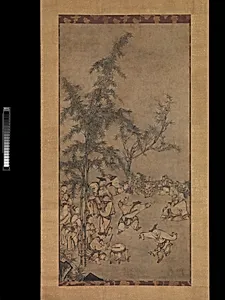
雪村周継筆 竹林七聖図|Seven Sages of the Bamboo Grove
1550s
Medium
Hanging scroll; ink and color on paper
Dimensions
Image: 40 5/16 × 20 3/8 in. (102.4 × 51.7 cm) Overall with mounting: 79 3/4 × 26 7/16 in. (202.5 × 67.2 cm) Overall with knobs: 79 3/4 × 28 9/16 in. (202.5 × 72.6 cm)
Classification
Paintings
Culture & Period
Japan · Muromachi period (1392–1573)
Department
Asian Art
Museum
Metropolitan Museum of Art, New York, NY
Credit
Mary Griggs Burke Collection, Gift of the Mary and Jackson Burke Foundation, 2015
Accession Number
2015.300.50
Rights
Public Domain
Tags
Art Historical Context
In the serene bamboo grove depicted in *Seven Sages of the Grove*, painted by Sesson Shūkei in the 1550s during Japan's Muromachi period (1392–1573), we encounter a timeless celebration of reclusive wisdom and joyful camaraderie. This hanging scroll, rendered in ink and light color on paper, captures the legendary Chinese Seven Sages—erudite scholars who withdrew from corrupt politics in the 3rd century to revel in nature, music, dance, wine, and conversation amid rustling bamboo. Sesson's composition brings this Daoist ideal to life with figures—men and women—playfully dancing and playing flutes, evoking harmony between humanity and the natural world. As a master of the Zen-influenced ink painting tradition, Sesson, a follower of the renowned Sesshū Tōyō, infused his work with bold, expressive brushwork characteristic of literati-style painting. Hanging scrolls like this one were prized in Muromachi-era Japan for their ritual display during gatherings, unrolling to transform a room into an immersive scene. The artwork's cultural resonance lies in its promotion of escapist ideals amid feudal turmoil, blending Chinese literary heritage with Japanese aesthetics. Measuring over six feet when fully mounted, this piece from the Metropolitan Museum of Art's Mary Griggs Burke Collection invites viewers to pause and reflect on simplicity's profound joys.
About the Artist
Sesson Shūkei · 1500–1600
ca. 1504–ca. 1589