
Sgra-Snyan
Unknown Artist
19th century
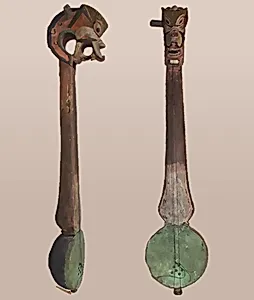
Medium
Wood, hide
Dimensions
L.: 62 cm (24-1/2 in.); W.: 13 cm ( 5-1/8 in.); D.: 13 cm (5-1/8 in.)
Classification
Chordophone-Lute-plucked-unfretted
Culture
Nepalese
Department
Musical Instruments
Museum
Metropolitan Museum of Art, New York, NY
Credit
Purchase, Clara Mertens Bequest, in memory of André Mertens, 1990
Accession Number
1990.112.5
Rights
Public Domain
Art Historical Context
Nestled in the Metropolitan Museum of Art's collection of musical instruments, the *Sgra-Snyan* is a captivating 19th-century Nep lute, classified as a chordophone—specifically a plucked, unfretted lute. Crafted from wood and hide, it measures 62 cm in length, with a compact width and depth of 13 cm, making it portable yet resonant. The wooden body provides structural integrity and acoustic warmth, while the hide likely forms the soundboard, a traditional technique in Himalayan instrument-making that amplifies vibrations for a rich, melodic tone. This unfretted design allows for continuous pitch bending and microtonal subtleties, hallmarks of Nepalese musical traditions influenced by Buddhist rituals, folk performances, and courtly ensembles. Dating to the 19th century, it reflects a period of cultural flourishing in Nepal, where such lutes bridged spiritual and secular life, evoking the Himalayas' ethereal soundscapes. Acquired through the Clara Mertens Bequest in memory of André Mertens in 1990, this rare piece invites visitors to imagine its strings humming with ancient melodies, preserving Nepal's sonic heritage for modern ears.