
Shadows on the Shoji
1790s
Medium
Woodblock print; ink and color on paper
Dimensions
H. 15 1/2 in. (39.4 cm); W. 10 in. (25.4 cm)
Classification
Prints
Culture & Period
Japan · Edo period (1615–1868)
Department
Asian Art
Museum
Metropolitan Museum of Art, New York, NY
Credit
Gift of Estate of Samuel Isham, 1914
Accession Number
JP978
Rights
Public Domain
Tags
Art Historical Context
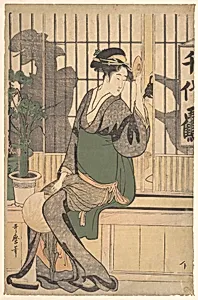
**Shadows on the Shoji** Kitagawa Utamaro the delicate beauty of everyday life in Edo-period Japan (1615–1868). in the 1790s, this woodblock print exemplifies Utamaro's mastery ofbijin-ga*, intimate portraits of women that celebrate feminine grace and poise. As one of the leading artists of the ukiyo-e ("pictures of the floating world") movement, Utamaro elevated the genre with his keen observation of light, texture, and emotion, often depicting courtesans or ladies in serene domestic settings. The title refers to *shoji*—traditional Japanese sliding screens made of translucent paper—which play a starring role here. Silhouettes cast on these screens create a poetic interplay of shadow and light, a technique that adds depth and mystery without revealing full figures. Printed with vibrant inks and colors on paper in the standard *oban* size (15½ × 10 inches), the work showcases the collaborative precision of woodblock printing: carvers, printers, and publishers working in harmony to produce affordable art for urban audiences. Housed in the Metropolitan Museum of Art's Asian Art Department since 1914, this print reflects Japan's vibrant print culture during a time of peace and prosperity. It invites viewers to ponder the hidden lives behind the screens, blending sensuality with subtle elegance—a timeless hallmark of Utamaro's enduring legacy.
About the Artist
Kitagawa Utamaro · 1753–1806
Kitagawa Utamaro (c. 1753-1806) was one of the most celebrated masters of ukiyo-e woodblock printing, revolutionizing the art of bijin-ga (pictures of beautiful women) during Japan's Edo period. Born Kitagawa Ichitaro, his early life remains shrouded in mystery, with conflicting accounts placing his birth in Kyoto, Osaka, Yoshiwara in Edo (modern Tokyo), or Kawagoe in Musashi Province. Under the t...