
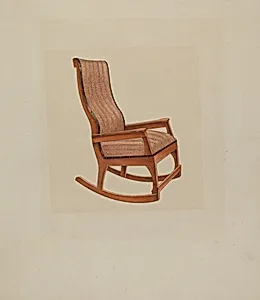
Shaker Rocking Chair
c. 1938
Medium
watercolor, pen and ink, and graphite on paper
Dimensions
overall: 36.5 x 30.4 cm (14 3/8 x 11 15/16 in.)
Classification
Index of American Design
Department
CG-W
Museum
National Gallery of Art, Washington, D.C.
Credit
Index of American Design
Accession Number
1943.8.16630
Rights
Public Domain
Art Historical Context
Behold the elegant simplicity of *Shaker Rocking Chair*, a meticulously rendered depiction by artist Lon Cronk around 1938. Created as part of the Federal Art Project's Index of American Design—a WPA initiative during the Great Depression—this watercolor, pen and ink, and graphite drawing on paper (36.5 x 30.4 cm) preserves the essence of Shaker craftsmanship. The Index employed over 400 artists to document thousands of everyday American objects, safeguarding cultural heritage amid economic hardship and highlighting the nation's folk art traditions. Shaker furniture, born from the United Society of Believers in Christ's Second Appearing—a 19th-century religious community in the American Northeast—embodies their ethos of austerity, functionality, and spiritual purity. Known for unadorned forms, precise joinery, and durable woods like maple or cherry, pieces like this rocking chair prioritized utility over ornamentation, influencing modern design movements such as Mid-Century Modern. Cronk's work captures the chair's graceful curves and balanced proportions, evoking the quiet rhythm of Shaker life. Cronk's mixed-media technique—vibrant watercolor washes for wood grain, fine pen lines for contours, and graphite for subtle shading—brings hyper-realistic precision to the artifact. Housed in the National Gallery of Art's collection (Department CG-W), this drawing not only revives a vanished craft but invites us to appreciate how everyday objects reflect profound cultural values. A testament to American ingenuity!
About the Artist
Lon Cronk · 1855–present
Lon Cronk remains one of the more elusive figures in the broader history of art, with biographical records offering little concrete detail about his life, training, or national background. The limited documentation surrounding his career makes it difficult to situate him within a specific movement or tradition, though works attributed to him suggest a practitioner of some technical competence. Wh...