
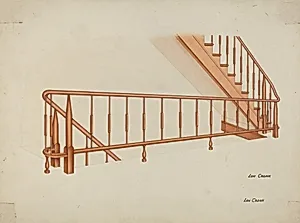
Shaker Stairway
c. 1941
Medium
watercolor and graphite on paperboard
Dimensions
overall: 26.9 x 35.8 cm (10 9/16 x 14 1/8 in.)
Classification
Index of American Design
Department
CG-W
Museum
National Gallery of Art, Washington, D.C.
Credit
Index of American Design
Accession Number
1943.8.13655
Rights
Public Domain
Art Historical Context
**Shaker Stairway** by Lon Cronk, created around 1941, is a captivating watercolor and graphite rendering on paperboard, measuring 26.9 x 35.8 cm. Part of the Index of American Design—a groundbreaking WPA Federal Art Project from the 1930s and early 1940s—this work exemplifies efforts to document and celebrate America's folk art and design heritage during the Great Depression. Artists like Cronk produced meticulous, full-color studies of everyday objects and architecture, preserving cultural treasures for future generations now housed at the National Gallery of Art. The artwork depicts a classic Shaker stairway, evoking the Shakers' 19th-century religious communities renowned for their minimalist, functional aesthetic. Shaker design emphasized simplicity, utility, and exquisite craftsmanship, principles vividly captured here through Cronk's precise graphite outlines and delicate watercolor washes. This medium allowed for accurate color reproduction and fine detail, making the Index renderings invaluable references superior to photographs in conveying texture and form. As a cultural artifact itself, **Shaker Stairway** highlights America's regional ingenuity and spiritual traditions, reminding us how everyday architecture embodied profound values. Visitors will appreciate its role in bridging art, history, and design, inviting reflection on enduring American ideals of beauty in restraint.
About the Artist
Lon Cronk · 1855–present
Lon Cronk remains one of the more elusive figures in the broader history of art, with biographical records offering little concrete detail about his life, training, or national background. The limited documentation surrounding his career makes it difficult to situate him within a specific movement or tradition, though works attributed to him suggest a practitioner of some technical competence. Wh...