
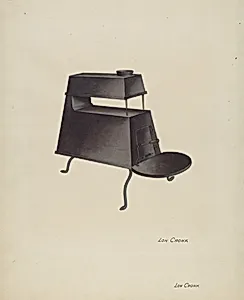
Shaker Stove
c. 1941
Medium
watercolor and pen and ink on paper
Dimensions
overall: 36.9 x 28.3 cm (14 1/2 x 11 1/8 in.)
Classification
Index of American Design
Department
CG-W
Museum
National Gallery of Art, Washington, D.C.
Credit
Index of American Design
Accession Number
1943.8.17144
Rights
Public Domain
Art Historical Context
**Shaker Stove** *Lon Cronk, c. 1941* Watercolor and pen and ink on paper, 36.9 × 28.3 cm *Index of American Design, National Gallery of Art* by artist Lon Cronk around 1941, *Shaker Stove* is a meticulous rendering from the Index of American Design, a landmark WPA Federal Art Project of the 1930s and 1940s. During the Great Depression, this initiative employed artists to document America's folk art, crafts, and everyday objects through precise watercolor studies. These works celebrated the nation's cultural heritage, preserving designs at risk of being lost to time and industrialization. Cronk's piece captures the essence of Shaker craftsmanship, a 19th-century religious community's hallmark of simplicity, functionality, and unadorned beauty. The subject—a Shaker stove—embodies the sect's philosophy of "Shaker simplicity," where every form served a practical purpose without excess ornamentation. Shakers, known for their communal living and innovative designs in furniture and tools, produced items like this that blended utility with elegant geometry. Rendered in watercolor and pen and ink on paper, Cronk's technique highlights fine details, subtle color washes, and sharp lines, making the ordinary extraordinary. This medium was ideal for the Index, allowing accurate replication while evoking the object's tactile warmth. Today, housed in the National Gallery of Art, *Shaker Stove* invites us to appreciate how everyday American design reflects deeper values of ingenuity and restraint—a timeless reminder of our inventive past.
About the Artist
Lon Cronk · 1855–present
Lon Cronk remains one of the more elusive figures in the broader history of art, with biographical records offering little concrete detail about his life, training, or national background. The limited documentation surrounding his career makes it difficult to situate him within a specific movement or tradition, though works attributed to him suggest a practitioner of some technical competence. Wh...