
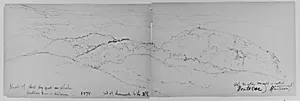
Shawangunk Mt., Catskills, 1871 (from Sketchbook)
ca. 1870
Medium
Graphite on paper
Dimensions
5 1/2 x 8 3/4 in. (14 x 22.2 cm)
Classification
Drawing
Culture
American
Department
The American Wing
Museum
Metropolitan Museum of Art, New York, NY
Credit
Gift of S.B. Luyster, 1936
Accession Number
36.124w recto
Rights
Public Domain
Tags
Art Historical Context
Daniel Huntington's *Shawangunk Mt.,kills, 1871 (from Sketchbook)* captures rugged beauty of New York's Catskill Mountains in a intimate graphite sketch. Created around 1870, this small drawing (5 1/2 x 8 3/4 inches) reflects the 19th-century American fascination with the nation's wild landscapes, a hallmark of the Hudson River School to which Huntington contributed through his landscapes and portraits. As a leading figure in American art and president of the National Academy Design, Huntington often sketched en plein air to study nature's forms, preserving fleeting moments of the Shawangunk range's dramatic hills. Rendered in graphite on paper, the work showcases the artist's precise technique for rendering texture and light in preliminary studies. These sketchbook pages were vital tools for artists like Huntington, bridging observation and finished canvases that celebrated America's natural heritage amid rapid industrialization. Housed in The Metropolitan Museum of Art's American Wing since a 1936 gift, it offers visitors a glimpse into the creative process behind grand Romantic visions of the Catskills. This piece invites us to appreciate the quiet power of everyday sketches, evoking the fresh mountain air and the era's reverence for untamed wilderness.
About the Artist
Daniel Huntington · 1816–1906
Daniel Huntington (1816–1906) was born into a prominent New York family on October 4, 1816, descending from distinguished New England lineage. His early education began at age fourteen at Smith's Academy in New Haven, followed by Yale College, where he studied with Samuel F. B. Morse, the inventor, artist, and president of the National Academy of Design, in 1835. After a disciplinary incident invo...