
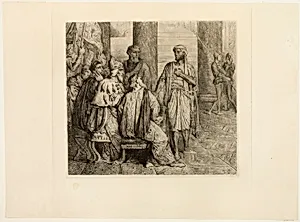
She Lov'd Me for the Dangers, plate three from Othello
Medium
Etching, engraving, roulette and drypoint on ivory China paper, laid down on ivory wove paper
Dimensions
Chine: 28.7 × 33.9 cm (11 5/16 × 13 3/8 in.); Plate: 34.5 × 36.4 cm (13 5/8 × 14 3/8 in.); Sheet: 39.5 × 52.8 cm (15 9/16 × 20 13/16 in.)
Classification
etching
Department
Prints and Drawings
Museum
Art Institute of Chicago
Accession Number
40770
Rights
Public Domain
Art Historical Context
Théodore Chassériau's *She Lov'd Me for the Dangers*, plate three from his *Othello* series, captures a poignant moment from Shakespeare's tragedy. Created in 1844, this etching draws from Othello's famous line recounting how Desdemona fell in love with his tales of peril and adventure. At just 25, the French artist—pupil of Ingres and influenced by Romanticism—produced this as part of a suite illustrating the play, reflecting the 19th-century fascination with Shakespearean drama amid Europe's Romantic revival. Chassériau masterfully combines etching, engraving, roulette, and drypoint on delicate ivory China paper, laid down on ivory wove paper. These techniques allow for intricate textures—roulette for subtle tonal gradations, drypoint for rich, velvety lines—evoking emotional depth and dramatic light. Measuring nearly 35 cm across the plate, the print's scale enhances its theatrical intensity, making it a standout in reproductive printmaking, which democratized access to literary imagery. Housed in the Art Institute of Chicago's Prints and Drawings department, this work exemplifies Chassériau's blend of neoclassical precision and Romantic passion, bridging painting and print traditions. Visitors will appreciate its narrative power, inviting reflection on love, jealousy, and storytelling's dangers.
About the Artist
Théodore Chassériau · 1819–1856
Théodore Chassériau was born on September 20, 1819, in El Limón, Samaná, in the Spanish colony of Santo Domingo — present-day Dominican Republic — to a French father and a Creole mother. The family relocated to Paris in 1820, and the young Chassériau's exceptional talent was evident almost immediately. At just eleven years old, in 1830, he was accepted into the prestigious studio of Jean-Auguste-D...