
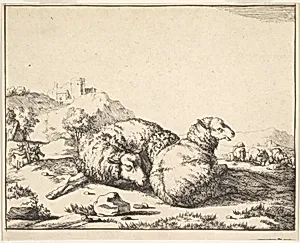
Sheep, from a set of 16 plates
1664
Medium
Etching
Dimensions
sheet: 4 7/16 x 5 1/2 in. (11.2 x 14 cm)
Classification
Prints
Department
Drawings and Prints
Museum
Metropolitan Museum of Art, New York, NY
Credit
Bequest of Phyllis Massar, 2011
Accession Number
2012.136.668.3
Rights
Public Domain
Tags
Art Historical Context
In the heart of 17th-century printmaking shines *Sheep, from a set of 16 plates*, a delicate etching by Marcus de Bye from 1664. This petite work, measuring just 4 7/16 x 5 1/2 inches (11.2 x 14 cm), captures the quiet nobility of its woolly subjects, inviting viewers into a world of pastoral simplicity. As one plate in a larger series, it reflects the era's fascination with animal studies, likely appealing to collectors who prized detailed natural depictions for study or decoration. Etching, de Bye's chosen medium, exemplifies the technical innovation of the time: artists drew into a wax ground on a copper plate, allowing acid to etch fine, expressive lines that convey texture and movement with remarkable precision. This process made prints affordable and reproducible, democratizing art beyond paintings. Sheep, as everyday farm animals, symbolize the rural life central to Dutch society during this period of prosperity. Today, this gem resides in the Metropolitan Museum of Art's Drawings and Prints department, thanks to the generous bequest of Phyllis Massar in 2011. Pause here to appreciate how de Bye's modest etching bridges art and nature, offering timeless insight into 17th-century observation.