
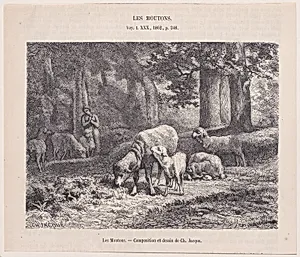
Sheep, from "Le Magasin Pittoresque"
Medium
Wood engraving
Dimensions
Sheet (Trimmed): 5 13/16 × 7 1/16 in. (14.8 × 17.9 cm) Image: 4 3/8 × 5 7/8 in. (11.1 × 15 cm)
Classification
Prints
Department
Drawings and Prints
Museum
Metropolitan Museum of Art, New York, NY
Credit
Harris Brisbane Dick Fund, 1933
Accession Number
32.36.26
Rights
Public Domain
Tags
Art Historical Context
Welcome to the Metropolitan Museum of Art's Drawings and Prints collection, where you'll find *Sheep, from "Le Magasin Pittores"*, a delicate wood engraving created in 1862 by artist Charles Jacque and engraver François Rouget. This intimate image, measuring just 4 3/8 × 5 7/8 inches, captures a flock of sheep in a pastoral scene, trimmed to a sheet of 5 13/16 × 7 1/16 inches. Produced for *Le Magasin Pittoresque*, a popular French illustrated magazine launched in 1833, it exemplifies the era's booming print culture, which brought affordable art reproductions to middle-class homes across Europe. Charles Jacque, a master of the animalier genre and associated with the Barbizon school's realist tendencies, specialized in rural livestock like sheep, infusing his works with naturalistic detail and a deep appreciation for everyday farm life. Wood engraving, the medium here, was a 19th-century innovation using end-grain boxwood blocks for crisp, fine lines ideal for magazine presses—allowing high-volume production without sacrificing precision. Rouget's skilled translation of Jacque's design onto wood highlights the collaborative artistry behind such prints. Acquired through the Harris Brisbane Dick Fund in 1933, this piece reflects the cultural role of periodicals in democratizing visual storytelling, blending education and entertainment amid France's industrial and agricultural shifts. A charming window into 1860s rural idyll! (198 words)
About the Artist
Charles Jacque|François Rouget · 1813–1894
Charles-Émile Jacque (1813–1894) was a pioneering French painter, engraver, and illustrator whose career bridged the worlds of printmaking and pastoral painting. Born in Paris amid a difficult childhood, he apprenticed at age seventeen to a map engraver, mastering drypoint technique and producing his first etching in 1830—a copy of a head after Rembrandt. After serving seven years in the French Ar...