
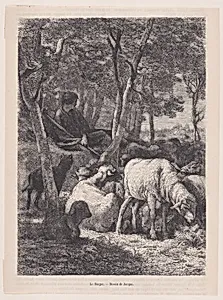
The Shepherd, from "Le Magasin Pittoresque"
ca. 1852
Medium
Wood engraving
Dimensions
Sheet (Trimmed): 9 1/16 × 6 15/16 in. (23 × 17.6 cm) Image: 8 1/8 × 5 7/8 in. (20.6 × 15 cm)
Classification
Prints
Department
Drawings and Prints
Museum
Metropolitan Museum of Art, New York, NY
Credit
Harris Brisbane Dick Fund, 1933
Accession Number
32.36.5
Rights
Public Domain
Tags
Art Historical Context
This charming wood engraving, titled *The Shepherd*, appeared around 1852 in the pages of *Le Magasin Pittoresque*, a popular French illustrated magazine dedicated to making art, science, and culture accessible to a broad readership. Created by Charles Jacque in collaboration with engraver Françoisget, the print exemplifies the mid-nineteenth-century boom in periodical illustration, where wood engraving allowed artists to reach thousands of homes with finely detailed images at relatively low cost. The scene depicts a lone shepherd amid his flock, rendered with the careful linework and tonal contrast typical of the medium. Jacque, associated with the Barbizon school, brought his deep interest in rural life and animal subjects to the composition, capturing both the quiet dignity of pastoral work and the textures of wool, grass, and weathered clothing. Such images helped city dwellers connect with the French countryside during a period of rapid urbanization. Acquired by the Metropolitan Museum of Art through the Harris Brisbane Dick Fund in 1933, this trimmed sheet preserves a vivid example of how printmaking bridged fine art and everyday visual culture in the Victorian era.
About the Artist
Charles Jacque|François Rouget · 1813–1894
Charles-Émile Jacque (1813–1894) was a pioneering French painter, engraver, and illustrator whose career bridged the worlds of printmaking and pastoral painting. Born in Paris amid a difficult childhood, he apprenticed at age seventeen to a map engraver, mastering drypoint technique and producing his first etching in 1830—a copy of a head after Rembrandt. After serving seven years in the French Ar...