
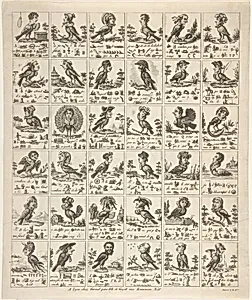
Sheet of Rebuses with Birds with Human Heads
Medium
Etching and engraving on laid paper
Dimensions
sheet: 13 1/2 x 11 1/4 in. (34.3 x 28.6 cm)
Classification
Prints
Department
Drawings and Prints
Museum
Metropolitan Museum of Art, New York, NY
Credit
Bequest of William S. Lieberman, 2005
Accession Number
2007.49.390
Rights
Public Domain
Art Historical Context
This anonymous French print from around 1834, titled *Sheet of Rebuses with Birds with Human Heads*, presents a lively array of pictorial puzzles on a modest sheet of laid paper. Associated with the Giraud family of printers (including Michel, Antoine, and Aimé Giraud) along with Benoît Gayet, the work uses etching and engraving to depict birds given human heads as the central figures in these visual riddles. Rebuses rely on images standing in for words or syllables, turning the sheet into an interactive challenge that blends observation with wordplay. Etching (using acid to bite lines into a metal plate) combined with engraving (incising directly with a tool) produced the fine, reproducible details needed for such intricate designs, allowing impressions to circulate. The hybrid bird-human creatures add a layer of imaginative charm, transforming what might otherwise be straightforward puzzles into something more fantastical and memorable. Now in the Metropolitan Museum of Art’s Drawings and Prints collection thanks to William S. Lieberman’s 2005 bequest, the print offers a window into 19th-century French visual culture, where printed sheets served as both artistic objects and sources of amusement. It reminds us how everyday entertainment could also showcase technical skill and creative invention.
About the Artist
Anonymous, French, 19th century|Giraud, Pere et Fils et Gayet|Michel Giraud|Benoît Gayet|Antoine Giraud|Aimé Giraud · 1800–1900
**Anonymous, French, 19th Century (ca. 1800–1900)** The artist cataloged as Anonymous, French, 19th century embodies the enigmatic yet essential contributions of unidentified creators to France's vibrant 19th-century art world. Active roughly between 1800 and 1900, this figure—or potentially collective workshop—produced a diverse array of works amid the nation's transition from Neoclassicism thro...