
Sheet of Studies (replica)
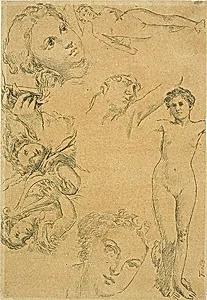
Medium
Black crayon, on tan tracing paper, laid down on card
Dimensions
25.8 × 17.7 cm (10 3/16 × 7 in.)
Classification
crayon
Department
Prints and Drawings
Museum
Art Institute of Chicago
Accession Number
80617
Rights
Public Domain
Art Historical Context
Henri Fantin-Latour (1836–1904), a prominent French artist of the Realism movement, was renowned for his meticulous portraits, intimate group scenes, and delicate still lifes. This *Sheet of Studies (replica)*, housed in the Art Institute of's Prints and Drawings department exemplifies his preparatory work. Though undated, it captures the artist's exploratory process through quick, expressive sketches—likely figures or compositions—rendered in black crayon on tan tracing paper, then laid down on card for preservation. At 25.8 × 17.7 cm, its intimate scale invites close inspection. Tracing paper was a favored medium in the 19th century for its translucency, allowing artists like Fantin-Latour to overlay and refine ideas or trace from life models. This technique highlights his precision and spontaneity, bridging the gap between observation and finished painting. As a replica, it preserves the original's vitality, offering museum visitors a window into the artist's studio practice amid the evolving Parisian art scene, where he befriended Realists like Manet and Courbet. Such study sheets reveal the groundwork behind Fantin-Latour's polished canvases, underscoring how 19th-century draftsmen valued iteration. A charming glimpse into creative labor, it reminds us that masterpieces often begin with humble crayon marks.
About the Artist
Henri Fantin-Latour · 1836–1904
Ignace Henri Jean Théodore Fantin-Latour was born on January 14, 1836, in Grenoble, France, to portrait painter Théodore Fantin-Latour, who gave him his earliest drawing lessons. The family relocated to Paris in 1841, where in 1850, at age 14, he enrolled in the École de Dessin, studying under Horace Lecoq de Boisbaudran, whose innovative memory-based method of drawing from observation profoundly ...