
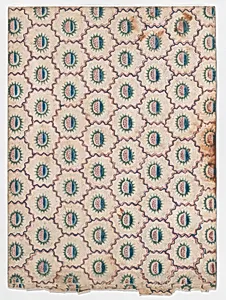
Sheet with abstract pattern with curved lines and dots
19th century
Medium
Relief print (wood or metal)
Dimensions
Sheet: 8 7/16 × 11 5/8 in. (21.4 × 29.6 cm)
Classification
Prints
Department
Drawings and Prints
Museum
Metropolitan Museum of Art, New York, NY
Credit
The Elisha Whittelsey Collection, The Elisha Whittelsey Fund, 1948
Accession Number
48.142.54
Rights
Public Domain
Art Historical Context
This intriguing 19th-century sheet features an abstract pattern of flowing curved lines and scattered dots, created anonymously through relief printing—a technique using carved wood or metal blocks where surfaces are inked and pressed onto paper Measuring 8 7/16 × 11 5/8 inches (21.4 × 29.6 cm), it exemplifies the era's fascination with repeatable decorative motifs, often produced for textiles, wallpapers, or bookbinding. Relief printing, popular in the 19th amid the Industrial Revolution, allowed for efficient mass production of intricate designs, blending craftsmanship with emerging mechanization. The rhythmic curves and dots suggest influences from nature or ornamental traditions, evoking a sense of movement and whimsy typical of pattern books used by artisans. Housed in the Metropolitan Museum of Art's Drawings and Prints department as part of The Elisha Whittelsey Collection (acquired via The Elisha Whittelsey Fund in 1948), this print offers a glimpse into everyday artistic innovation. It highlights how anonymous makers shaped visual culture, bridging fine art and design in a transformative century.
About the Artist
Anonymous
In the vast tapestry of art history, "Anonymous" stands not as a singular individual but as a collective designation for countless unidentified creators whose works have endured across millennia. These artists, spanning prehistoric cave painters to medieval illuminators and folk craftsmen, produced the foundational layers of human visual culture. Prior to the Renaissance, when individual fame emer...