
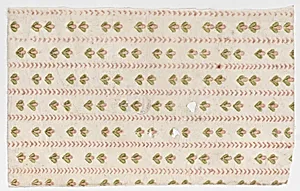
Sheet with an overall floral pattern
19th century
Medium
Relief print (wood or metal)
Dimensions
Sheet: 6 5/8 × 4 1/8 in. (16.8 × 10.5 cm)
Classification
Prints
Department
Drawings and Prints
Museum
Metropolitan Museum of Art, New York, NY
Credit
Harris Brisbane Dick Fund, 1939
Accession Number
39.13.240
Rights
Public Domain
Art Historical Context
This delicate *Sheet with an Overall Floral Pattern*, created anonymously in the 19 century, exemplifies the era's fascination with nature-inspired designs. Measuring just 6 5/8 × 4 1/8 inches (16.8 × 10.5 cm), this small print from the Metropolitan Museum of Art Drawings and Prints department captures a repeating floral motif, likely intended for decorative use such as textiles, wallpaper, or book illustrations. Acquired through the Harris Brisbane Dick Fund 1939, it the museum's commitment to preserving everyday artistic expressions from the period. Crafted as a relief print—produced by inking a raised surface on wood or metal and pressing it onto paper—this technique was widely used in the 19th century for its efficiency in creating intricate, repeatable patterns. During the Victorian age, floral motifs symbolized abundance, beauty, and the Romantic idealization of nature, appearing everywhere from fashion to home furnishings amid the Industrial Revolution's push for mass-produced ornamentation. Though the artist remains unknown, the print's precise execution highlights the skilled craftsmanship of anonymous printmakers who fueled Europe's decorative arts boom. Visitors will appreciate its timeless charm, a window into how everyday beauty was democratized through innovative printing methods.
About the Artist
Anonymous
In the vast tapestry of art history, "Anonymous" stands not as a singular individual but as a collective designation for countless unidentified creators whose works have endured across millennia. These artists, spanning prehistoric cave painters to medieval illuminators and folk craftsmen, produced the foundational layers of human visual culture. Prior to the Renaissance, when individual fame emer...