
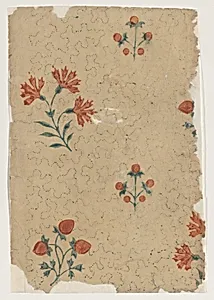
Sheet with overall dot pattern with bouquets
19th century
Medium
Relief print (wood or metal)
Dimensions
Sheet: 8 9/16 × 5 13/16 in. (21.8 × 14.8 cm)
Classification
Prints
Department
Drawings and Prints
Museum
Metropolitan Museum of Art, New York, NY
Credit
Harris Brisbane Dick Fund, 1926
Accession Number
26.71.9(8a)
Rights
Public Domain
Art Historical Context
This charming 19th-century relief print, titled *Sheet with overall dot pattern with bouquets*, showcases an anonymous artist's skill in creating repeatable decorative motifs. Measuring a compact 8 9/16 × 5 13/16 inches, the sheet features a lively all-over dot pattern interspersed with bouquets of flowers, evoking the floral abundance popular in Victorian-era design. Produced as a print from wood or metal blocks, it likely served as a pattern sample for textiles, wallpapers, or book covers, reflecting the era's growing demand for affordable, mass-reproducible ornamentation. Relief printing, the technique used here, involves carving away non-image areas from a block, leaving raised surfaces to be inked and pressed onto paper. This method, dating back centuries but thriving in the 19th century with industrialization, allowed for precise dotting effects—possibly stippling for texture—and vibrant, repeating floral elements. The anonymity underscores the collaborative nature of pattern workshops, where skilled craftspeople produced designs for everyday luxury. Housed in the Metropolitan Museum of Art's Drawings and Prints department (Harris Brisbane Dick Fund, 1926), this piece offers a window into 19th-century decorative arts, highlighting how simple prints democratized beauty in homes and objects. Visitors will appreciate its whimsical elegance, a testament to the artistry behind everyday patterns.
About the Artist
Anonymous
In the vast tapestry of art history, "Anonymous" stands not as a singular individual but as a collective designation for countless unidentified creators whose works have endured across millennia. These artists, spanning prehistoric cave painters to medieval illuminators and folk craftsmen, produced the foundational layers of human visual culture. Prior to the Renaissance, when individual fame emer...