
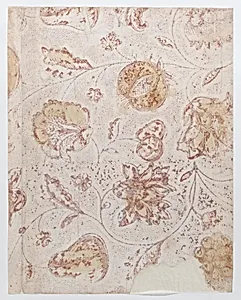
Sheet with overall floral, fruit, and dot pattern
19th century
Medium
Relief print (wood or metal)
Dimensions
Sheet: 7 9/16 × 9 9/16 in. (19.2 × 24.3 cm)
Classification
Prints
Department
Drawings and Prints
Museum
Metropolitan Museum of Art, New York, NY
Credit
Harris Brisbane Dick Fund, 1939
Accession Number
39.13.268
Rights
Public Domain
Art Historical Context
This delicate 19th-century relief print, titled *Sheet with overall floral,, and dot pattern*, an anonymous artist's mastery of repeating motifs in a compact sheet measuring just 7 9/16 × 9 9/16 inches. Created using a wood or metal block, the relief printing technique involves carving away negative space to leave raised designs that are inked and pressed onto paper This method, efficient for producing multiples, was ideal for pattern books used by textile designers, wallpaper manufacturers, and printers during the Industrial Revolution. Flourishing floral blooms, ripe fruits, and scattered dots create a lively, all-over design that evokes the Victorian era's love for ornate, nature-inspired decoration. Such patterns adorned everything from chintz fabrics to home furnishings, reflecting a cultural fascination with abundance and the exotic amid rapid urbanization. Acquired through the Harris Brisbane Dick Fund in 1939, this print now resides in The Metropolitan Museum of Art's Drawings and Prints department, offering a glimpse into the everyday artistry that shaped 19th-century interiors. Though anonymous, the work highlights the collaborative craft of print workshops, where precision and repetition turned simple blocks into endlessly versatile motifs, bridging fine art and functional design.
About the Artist
Anonymous
In the vast tapestry of art history, "Anonymous" stands not as a singular individual but as a collective designation for countless unidentified creators whose works have endured across millennia. These artists, spanning prehistoric cave painters to medieval illuminators and folk craftsmen, produced the foundational layers of human visual culture. Prior to the Renaissance, when individual fame emer...