
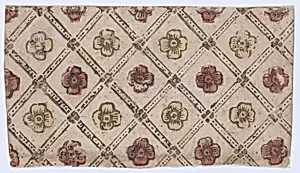
Sheet with overall pattern of rosettes
19th century
Medium
Relief print (wood or metal)
Dimensions
Sheet: 6 9/16 × 3 11/16 in. (16.7 × 9.4 cm)
Classification
Prints
Department
Drawings and Prints
Museum
Metropolitan Museum of Art, New York, NY
Credit
Harris Brisbane Dick Fund, 1939
Accession Number
39.13.256
Rights
Public Domain
Art Historical Context
Welcome to the Metropolitan Museum of Art's Drawings and Prints collection, where we encounter this charming 19th-century *Sheet with overall pattern ofsettes*, created anonymously using the relief print technique on wood or metal. Measuring a compact 6 9/16 × 3 11/16 inches (16.7 × 9.4 cm), this delicate sheet showcases a repeating motif of rosettes—stylized floral or star-like designs that evoke elegance and symmetry. Such patterns were staples in decorative arts, adorning textiles, wallpapers, and furnishings during an era of rapid industrialization. Relief printing, one of the oldest printmaking methods, involved carving away negative space from a block, leaving raised designs to be inked and pressed onto paper. This efficient technique allowed for the mass production of intricate patterns, revolutionizing design industries in the 19th century. Acquired through the Harris Brisbane Dick Fund in 1939, this piece likely served as a sample or reference for artisans, highlighting how anonymous craftspeople contributed to the visual language of everyday luxury. Steeped in the Aesthetic Movement's love for natural motifs, the rosettes here symbolize beauty and repetition, bridging fine art and functional design. A small treasure that whispers of bygone workshops, it invites us to appreciate the artistry in patterns that once dressed the world.
About the Artist
Anonymous
In the vast tapestry of art history, "Anonymous" stands not as a singular individual but as a collective designation for countless unidentified creators whose works have endured across millennia. These artists, spanning prehistoric cave painters to medieval illuminators and folk craftsmen, produced the foundational layers of human visual culture. Prior to the Renaissance, when individual fame emer...