
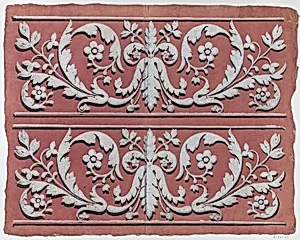
Sheet with two borders with rinceau motif
late 18th–mid-19th century
Medium
Relief print (wood or metal)
Dimensions
Sheet: 14 11/16 × 18 3/8 in. (37.3 × 46.7 cm)
Classification
Prints
Department
Drawings and Prints
Museum
Metropolitan Museum of Art, New York, NY
Credit
Gift of D. Lorraine Yerkes, 1961
Accession Number
61.651.27
Rights
Public Domain
Art Historical Context
This elegant sheet from the late 18th to mid-19th century showcases two decorative borders adorned with the rinceau motif—a graceful pattern of scrolling vines and foliage that echoes classical Roman and Renaissance ornament. Created as a relief print, likely through wood or metal engraving, the work exemplifies the kind of versatile design elements produced for practical use in books, frames, or larger compositions. Its modest dimensions of roughly 14 11/16 by 18 3/8 inches suggest it was intended as a reusable pattern rather than a standalone image. Attributed to the Remondini family or an anonymous artist working in their orbit, the print reflects the flourishing printmaking industry in northern Italy, particularly around Bassano del Grappa. The Remondini workshop became renowned for making refined decorative motifs accessible to a broad audience through affordable printing techniques. Such borders helped disseminate classical taste during a period when neoclassical styles were popular across Europe. Today, this sheet resides in the Metropolitan Museum of Art’s Department of Drawings and Prints, a gift from D. Lorraine Yerkes in 1961. It offers visitors a glimpse into the behind-the-scenes artistry that shaped everyday visual culture, reminding us how even functional designs carried forward centuries of aesthetic tradition.