
Shelf Clock
1935/1942
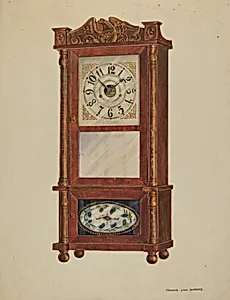
Medium
watercolor, colored pencil, pen and ink, and graphite on paper
Dimensions
overall: 36.5 x 28.3 cm (14 3/8 x 11 1/8 in.) Original IAD Object: none given
Classification
Index of American Design
Department
CG-W
Museum
National Gallery of Art, Washington, D.C.
Credit
Index of American Design
Accession Number
1943.8.4798
Rights
Public Domain
Art Historical Context
Behold the exquisite *Shelf Clock*, a meticulously rendered depiction created by artist Francis Law Durand between 1935 and 1942. This watercolor, colored pencil, pen and ink, and graphite drawing on paper (36.5 x 28.3 cm) captures the details of an American shelf clock, showcasing its elegant form and craftsmanship. Housed in the National Gallery of Art's collection, it exemplifies the precision and artistry of mid-20th-century documentation. As part of the Index of American Design—a groundbreaking WPA Federal Art Project from the Great Depression era—this work served a vital cultural mission. Launched in 1935, the IAD employed hundreds of artists to document thousands of everyday American objects, from folk art to decorative designs, preserving the nation's design heritage amid economic hardship. Durand's rendering highlights the shelf clock's historical role in American homes, blending functionality with aesthetic appeal. The mixed-media technique reveals Durand's skill: delicate watercolors evoke the wood tones and metallic gleam, while fine pen lines and graphite add architectural precision. This piece not only celebrates American ingenuity but also underscores the IAD's enduring legacy in fostering national pride through art. (198 words)
About the Artist
Francis Law Durand · 1855–present
**Francis Law Durand (1906–1995)** Born on March 31, 1906, in Mount Holly, New Jersey, Francis Law Durand emerged as a skilled American draftsman and artist during the Great Depression era. Little is known about his early life or formal training, as biographical details remain sparsely documented beyond his professional output. By 1935, he was employed by the Works Progress Administration (WPA), ...