
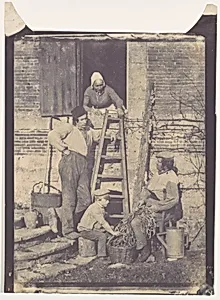
Shelling Beans, Argentelle
Medium
Salted paper print from paper negative
Dimensions
Image: 22.3 x 17.7 cm (8 3/4 x 6 15/16 in.)
Classification
Photographs
Department
Photographs
Museum
Metropolitan Museum of Art, New York, NY
Credit
Gilman Collection, Purchase, Mr. and Mrs. Henry R. Kravis Gift, 2005
Accession Number
2005.100.263
Rights
Public Domain
Tags
Art Historical Context
**Shelling Beans, Argentelle** (1851) by Louis-Adolphe Humbert de Molard captures a timeless moment of rural French life in Normandy. This salted paper print from a paper negative depicts men, women, and boys engaged in the simple, communal task of shelling beans amid ladders and harvest tools, evoking the rhythms of 19th-century peasant labor. At 22.3 x 17.7 cm, its intimate scale draws viewers into the scene's quiet authenticity, now housed in The Metropolitan Museum of Art's Gilman Collection. Created just a decade after photography's invention, the work exemplifies the calotype process—pioneered by William Henry Fox Talbot—where a paper negative allowed for multiple prints with a soft, painterly quality distinct from the sharp daguerreotypes of the era. Humbert de Molard, a pioneering French photographer, used this technique to document everyday Norman country scenes, blending artistic vision with social observation during a time of industrialization. Its cultural significance lies in preserving vanishing agrarian traditions, offering a poignant glimpse into mid-19th-century working life. Far from staged portraits, this image highlights photography's emerging power to record unposed humanity, making it a gem for understanding early photographic realism.