
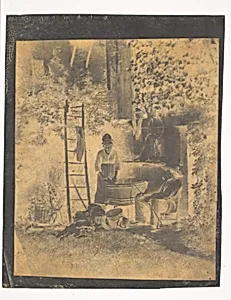
The Laundry
Medium
Albumen paper negative
Dimensions
Image: 5 13/16 × 5 5/16 in. (14.7 × 13.5 cm)
Classification
Negatives
Department
Photographs
Museum
Metropolitan Museum of Art, New York, NY
Credit
Gilman Collection, Purchase, Ann Tenenbaum and Thomas H. Lee Gift, 2005
Accession Number
2005.100.1240
Rights
Public Domain
Tags
Art Historical Context
Step into the dawn of photography with *The Laundry* (1840s), a pioneering albumen paper negative French photographer Louis-Adol Humbert de Molard Captured in the medium's infancy—just a decade after Louis Daguerre and William Henry Fox Talbot unveiled their processes—this 5 13/16 × 5 5/16 in. image exemplifies early experimental techniques. Humbert de Mol, active in Normandy, used albumen-sensitized paper to create detailed negatives, a fragile precursor to modern film that allowed multiple prints from a single exposure. The scene hums with everyday rural life: women at work washing and hanging laundry, scaling ladders to reach drying lines. These tags—women, ladders, washing—evoke the labor-intensive domestic routines of 19th-century France, where communal laundering was a social ritual blending toil and camaraderie. As a negative, the image inverts tones, offering a ghostly, ethereal view that highlights photography's novelty in freezing candid moments. Housed in The Metropolitan Museum of Art's Gilman Collection, *The Laundry* holds artistic significance as a rare survivor from photography's formative years. It bridges art and documentary, immortalizing overlooked female labor and showcasing the medium's potential to elevate the ordinary into the timeless. A window into Humbert de Molard's ethnographic eye, it reminds us how early photographers transformed sunlight into social history.