
Shepherd and His Flock
late 19th century
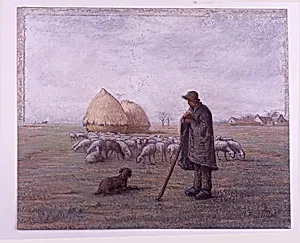
Medium
Pastel on papier bleuté
Dimensions
10 x 12 1/4 in. (25.4 x 31.1 cm)
Classification
Drawings
Department
Robert Lehman Collection
Museum
Metropolitan Museum of Art, New York, NY
Credit
Robert Lehman Collection, 1975
Accession Number
1975.1.670
Rights
Public Domain
Tags
Art Historical Context
In the serene "Shepherd and His F," Jean-François Millet captures the quiet dignity of rural life with a shepherd tending his sheep and dog in a pastoral landscape. Created in the late 19th century pastel on papier bleuté—a tinted blue paper that lends a subtle, atmospheric glow to the highlights—this intimate drawing measures just 10 x 12¼ inches. Now part of the Robert Lehman Collection at the Museum of Art, it Millet's masterful use of soft, blended pastels to evoke texture in woolly sheep and weathered clothing. Millet, a leading figure in the Realist movement and the Barbizon school, elevated everyday peasant scenes to subjects of profound artistic and social significance during an era of rapid industrialization. By focusing on shepherds and their flocks—symbols of timeless harmony with nature—he challenged the romanticized ideals of academic art, portraying laborers with empathy and realism. This work likely reflects his lifelong fascination with the French countryside, drawing from his own humble origins in Normandy. The delicate pastel technique allows for luminous effects and subtle color transitions, making this small-scale study feel expansive and evocative. Visitors will appreciate how Millet's humble motifs continue to resonate, bridging 19th-century rural traditions with universal themes of stewardship and solitude.
About the Artist
Jean-François Millet · 1814–1875
Jean-François Millet (1814-1875) was a French painter and one of the founders of the Barbizon school, whose dignified depictions of peasant laborers transformed how art could represent rural life. His monumental images of sowers, gleaners, and field workers elevated common people to subjects previously reserved for mythological or historical figures, making him a pivotal figure in the development ...