
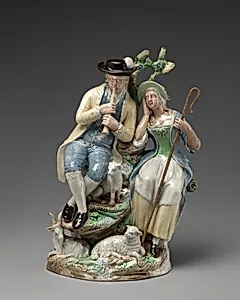
Shepherds
ca. 1770
Medium
Lead-glazed earthenware
Dimensions
Height: 10 1/8 in. (25.7 cm)
Classification
Ceramics-Pottery
Culture
British, Burslem, Staffordshire
Department
European Sculpture and Decorative Arts
Museum
Metropolitan Museum of Art, New York, NY
Credit
Rogers Fund, 1912
Accession Number
12.142.14
Rights
Public Domain
Tags
Art Historical Context
In the late 18th century, pottery kilns of Burslem, Staffordshire—heart of Britain's ceramics industry—produced charming earthenware figures like *Shepherds* by Ralph Wood the Youngerc. 1748–1795). Created around 1770, this lead-glazed earthenware sculpture just over 10 inches tall, a lively pastoral idyll. Wood, part of a renowned family of potters, specialized in colorful, molded figures that brought affordable whimsy to middle-class homes, blending folk art with emerging Rococo influences. The scene teems with rural life: shepherds (men and women), sheep, dogs, and goats gather amid musical instruments, evoking harmonious countryside leisure. Lead glazing gave these pieces their glossy, vibrant hues—typically in bright enamels over white slip—making them durable yet decorative tableaus. Mass-produced via molds but hand-painted, they reflected Georgian Britain's romanticization of pastoral simplicity amid industrialization. Acquired by The Metropolitan Museum of Art in 1912 via the Rogers Fund, *Shepherds* exemplifies Staffordshire pottery's cultural role: democratizing art for everyday enjoyment and preserving vignettes of pre-industrial life. A delightful glimpse into 18th-century whimsy!
About the Artist
Ralph Wood the Younger · 1748–1795
Ralph Wood the Younger was born in Burslem, Staffordshire, in 1748, the son of the celebrated potter Ralph Wood the Elder and a member of a family that stood at the center of the Staffordshire ceramics industry during its most creative and internationally influential period. Growing up in the workshops of his father, he absorbed from childhood the technical traditions of English earthenware produc...